How to Validate a Startup Idea Before You Build Anything

Most founders waste months building products nobody wants, simply because they skip the validation step. Testing a startup idea before writing a single line of code is not just smart; it is now entirely practical thanks to modern no-code tools that let anyone launch a working prototype in days. The best no-code SaaS builder platforms have lowered the barrier so much that real market feedback is accessible to founders at any budget or technical level.
Validation is about collecting honest signals from real potential customers, not assumptions made in a vacuum. Spotting a flawed premise early saves time, money, and significant frustration down the road. Founders who need to move quickly from concept to a testable product can work with a web app development company like Polsia to build and launch prototypes that generate the data needed to make confident decisions.
Table of Contents
- Why Most Startup Ideas Fail
- What Does It Mean to Validate a Startup Idea?
- 9 Steps to Validate a Startup Idea
- Common Startup Validation Mistakes to Avoid
- Signs Your Startup Idea Is Worth Pursuing
- How Polsia Helps First-Time Founders Validate and Launch Faster
- Start or Grow Your Existing Business with Polsia Today
Summary
- Roughly 42% of startups fail not because of poor execution or bad timing, but because there was no real market need for what they built, according to LinkedIn Pulse's Startup Failure Rate Statistics 2025. This single finding reframes the entire early-stage process. The most dangerous mistake a founder can make is treating development as a way to answer the market question rather than answering that question first, with minimal resources, before any serious building begins.
- Validation is not a one-time checkpoint before launch. Founders who treat it as an ongoing practice rather than a pre-launch phase are 2x more likely to succeed, according to siift.ai. Customer needs shift, pricing assumptions erode, and features that tested well in interviews can go unused in the actual product. The founders who stay close to evidence throughout the product lifecycle consistently outperform those who rely on internal conviction after the initial build.
- Behavioral signals are more reliable than verbal ones at every stage of the validation process. A waitlist signup, a pre-order, or a paid pilot tells you something that "I'd definitely use that" never can, because it costs the customer something real. NxCode notes that just 15 to 20 structured user interviews are enough to surface clear patterns, but only when those conversations are designed to reveal how people actually behave, not to collect agreement about a hypothetical solution.
- Talking to enough people before building is a discipline with a specific threshold. Research from Lenny's Newsletter suggests founders should speak with at least 25 potential customers before writing any code. That number matters because patterns only become visible at scale. Individual opinions are noise. Recurring pain points, described independently by strangers using similar language, are a signal worth acting on.
- Willingness to pay is the clearest filter in the entire validation process, and most founders delay testing it far too long. Collecting verbal enthusiasm and building spreadsheets of maybes creates the illusion of progress while deferring the only feedback that actually confirms a business model. Founders who introduce pricing conversations and commitment requests before the product is finished compress months of uncertainty into days, and the data they collect is categorically more honest than anything gathered through interest alone.
- Polsia, a web app development company, addresses this directly by giving solo founders the planning, research, and execution capacity to run structured validation workflows from day one, without needing to hire a team before they have confirmed the idea is worth building.
Why Most Startup Ideas Fail
According to LinkedIn Pulse's 2025 Startup Failure Rate Statistics, 42% of startups fail because there is no market need for their product. Not because the team was weak. Not because the timing was wrong. Because the founder built something the market never asked for.
"42% of startups fail because there is no market need for their product: not because of weak teams or bad timing, but because founders built what the market never asked for." — LinkedIn Pulse, 2025
🔑 Takeaway: Market need is the #1 killer of startups, outranking every other failure factor, including funding, talent, and execution.
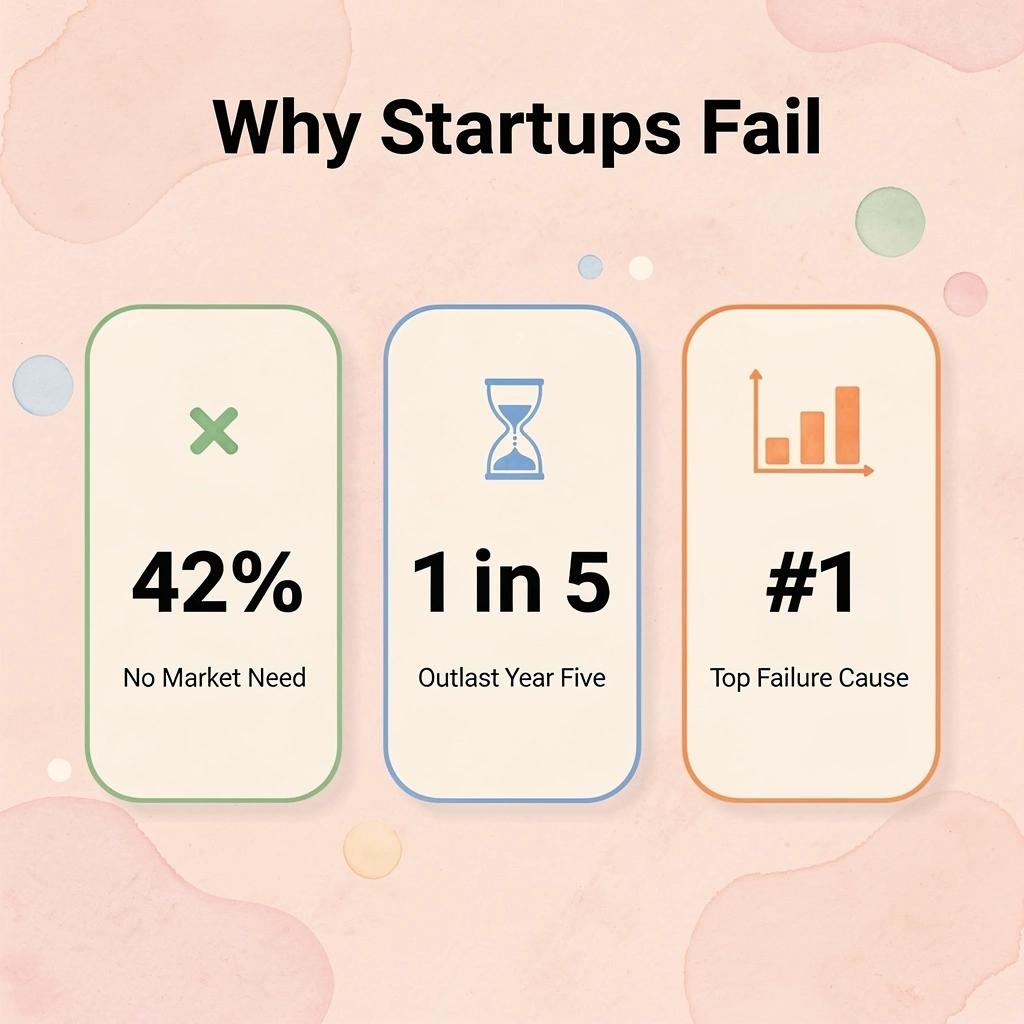
The pattern is clear: founders fall in love with a solution before confirming a real, painful problem exists. They spend months building features and refining design, only to discover that potential customers do not feel any need to use what was built. Most founders cannot clearly explain the one main problem their app solves — and that lack of clarity before building is what kills the product.
⚠️ Warning: If you cannot articulate the core problem your product solves in a single sentence, you are already at risk of joining the 42% that fail.
💡 Tip: Before writing a single line of code, validate that your target customer experiences the problem as urgent and painful — not just mildly inconvenient.
- No market need: Solution built without validating a genuine problem.
- Weak team: Gaps in execution after the initial concept.
- Wrong timing: Market conditions or external factors misaligned.
- Lack of clarity: Inability to articulate the core problem being solved.Why do founders build before they validate?
Most founders treat building as a way to answer whether their idea works. Building is expensive, slow, and emotionally draining. By the time you have a finished product, you are too invested to hear honest feedback clearly. The smarter path is to answer the market question first, using the lightest possible tools. A solo founder can test assumptions using landing pages, mockups, and direct customer conversations in days rather than months, without a team, budget, or permission. Polsia, a web app development company, helps founders move through this phase faster by using AI to handle the planning and research that once required a full team.
What does building without validation actually cost?
The financial cost of building without validation is real, but the opportunity cost is worse. LinkedIn Pulse's 2025 Startup Failure Rate Statistics report that 29% of startups fail because they run out of cash, with significant portions spent on building unwanted products. Six months of development, contractor fees, and infrastructure costs spent on an untested assumption are a sequencing problem, not a funding problem.
The barrier between having an idea and knowing whether it deserves to be built has never been lower. Speed is now a strategic advantage that any solo founder can leverage. Founders who move fast on validation, not building, reach product-market fit with resources still in the bank.
But knowing validation matters is only half the picture. What it means to validate an idea, and what real evidence looks like versus wishful thinking, is where most founders still get it wrong.
Related Reading
- Best No Code SaaS Builder
- How To Turn An Idea Into A Product
- Startup Product Development
- How To Start A Software Company
- How to Automate My Business
- How To Create A Digital Product
- How To Find A Cofounder
- How To Start an AI Company
- How To Start A Saas Business
What Does It Mean to Validate a Startup Idea?
Validation is the process of replacing founder optimism with customer evidence. It answers the question every serious entrepreneur must face: does a real market exist for this, and will people pay to access it?
"Validation is not about proving you're right — it's about discovering whether a real market exists before you invest everything into building." — Core Startup Principle
🎯 Key Point: Validation shifts your focus from what you believe to what customers prove.

According to Failory, 90% of startups fail, and a lack of market need is the single most common reason. This is a critical warning about building before listening.
⚠️ Warning: Skipping validation means you risk joining the 90% who build products nobody wants — no matter how strong your idea feels.
🔑 Takeaway: The #1 killer of startups isn't bad execution — it's solving a problem that doesn't exist for a market that was never there.
90% Failure Rate: Primarily caused by building a product for which there is no market need.
10% Success Rate: Primarily achieved by validating market demand before investing in development.
What validation is actually testing
Validation is not about proving your idea is good. It's about discovering whether a problem is urgent enough, frequent enough, and frustrating enough that strangers will spend money to solve it. Most founders run only one of these three tests: they confirm the problem exists, then skip straight to building, treating early enthusiasm as a green light. A customer nodding in an interview costs nothing. A customer handing over a credit card costs something real, and that difference is the entire point.
Why do most solo founders lack a validation system?
Most solo founders handle early validation with good intentions but no system. They talk to friends, post in communities, and interpret the absence of negative feedback as validation. The missing piece is structure: a repeatable method for testing assumptions by risk, starting with those most likely to kill the idea. A web app development company like Polsia is built around this kind of structured autonomy, giving a single founder the research, analysis, and operational capacity to run disciplined validation experiments without needing a team to design or execute them.
Validation is not a single moment
Validation does not end at launch. Customer needs shift, pricing assumptions erode, and features that tested well in interviews sometimes go untouched in the actual product. Treating validation as a pre-launch checklist rather than an ongoing practice leaves founders with products misaligned with their market. According to siift.ai, founders who validate their ideas are 2x more likely to succeed, and that advantage compounds when validation becomes a habit rather than a phase.
The real work of validation is stress-testing your riskiest assumptions before they become expensive mistakes. Knowing which assumptions to test first determines how fast you move.
9 Steps to Validate a Startup Idea
Knowing which assumptions to test first is only half the equation. You need a clear, repeatable process that moves you from idea to evidence without wasting weeks on the wrong activities.
"Startups that follow a structured validation process are dramatically more likely to build something the market actually wants — before burning through time and money." — Lean Startup Methodology
Here are the key activities and goals for each validation stage:
- Discovery: Conducting customer interviews to uncover genuine, actionable pain points.
- Definition: Mapping out assumptions to clearly identify and prioritize your critical risks.
- Testing: Deploying experiments and prototypes to gather hard, objective evidence.
- Decision: Analyzing your results to determine whether to pivot or persevere.
🎯 Key Point: A structured, step-by-step validation process is essential — it's the difference between building on solid evidence and burning resources on untested guesses.
💡 Tip: Before jumping into execution, map out your riskiest assumptions first. Tackling the most critical unknowns early saves you from wasting weeks — or even months — heading in the wrong direction.

Step 1: Start with the problem, not the solution
Founders often arrive with a finished product and then work backward to justify its necessity—inverting the validation logic. Instead, define the problem with precision: who experiences it, how often, and how much friction it creates. Occasional, mildly annoying problems rarely support a business. Frequent, painful, expensive-to-ignore problems almost always do.
Your definition of the target customer matters as much as the problem itself. Two customer segments can share the same surface-level problem but have different tolerances, budgets, and expectations for a solution.
Step 2: Research existing solutions before building anything
Study what people already use to manage the problem. Competitors signal that demand exists. More valuable are the gaps: the workarounds people have assembled using spreadsheets, manual processes, or combinations of tools never designed to work together. Those gaps reveal where frustration lives and where a better solution can grow.
Step 3: Talk to potential customers directly
According to Lenny's Newsletter, founders should talk to at least 25 potential customers before building. At this point, patterns emerge and recurring problems surface, indicating a genuine problem shared by many.
The key is to ask questions, not sell. Open-ended questions like "walk me through how you currently handle this" yield better information than "would you use a product that does X." When you're genuinely interested in learning, people reveal what's actually happening. When you're trying to sell them something, they agree with you.
Step 4: Analyze search demand and online communities
Search behavior shows honest signals: people type their real problems into search bars. Keyword research reveals whether demand is sustained or one-time. Consistent monthly search volume indicates a lasting market; a single spike suggests a trend, not a business.
Online communities add details that keyword data cannot. Reddit threads, niche forums, and LinkedIn discussions contain raw descriptions of frustration, failed solutions, and unmet needs—functioning as an unscripted focus group.
Step 5: Create a simple landing page
A landing page tests your message before you test your product. The goal is to discover whether your description of the problem and solution resonates with your target audience. If visitors arrive through targeted traffic and leave without engaging, the feedback is immediate: something in the framing is off.
How does building a landing page work for solo founders?
Solo founders once treated this step as a technical bottleneck, spending days on setup, copy, and forms before measuring anything. A web app development company like Polsia compresses what took a week of coordination into something a single founder can execute in an evening, without hiring a developer, designer, or marketer.
Step 6: Build a waitlist
A waitlist converts passive interest into an active signal. Someone who types in their email address is raising their hand—a behavior that differs from that of a passive page visitor. A waitlist of 200 genuinely interested people before launch is more valuable than 2,000 passive visitors who never return.
These early subscribers become your first research group. Email them directly, ask specific questions, and invite them to beta access. Treat them as collaborators, not leads.
Step 7: Test pricing before you finalize anything
People often say they like ideas, but won't pay for them. Discussing pricing early and directly reveals the real difference between interest and purchase intent. willingness to pay.
You don't need a payment processor or a finished product to test pricing. Ask people directly: "If this launched tomorrow at this price, would you buy it?" Pre-order experiments on a landing page yield more honest answers, since they require real decisions rather than hypothetical ones.
Step 8: Launch a Minimum Viable Product
After evidence builds up that real demand exists, launch a Minimum Viable Product focused on solving the core problem with the smallest set of features that delivers value. This means the smallest set that meaningfully improves the problem for the customer, not the smallest set you can get away with. An MVP that does too little teaches you nothing useful.
The purpose of an MVP is to learn. Every real user interaction produces data that no amount of pre-launch planning can replicate.
Step 9: Measure, adapt, and keep testing
Validation does not stop at launch. The most precise learning begins once real users make real decisions. Track engagement patterns, watch where users drop off, collect direct feedback, and monitor retention. A user who returns three times in the first week tells you something important. A user who never returns after day one is equally important—you need to hear both.
Why should founders treat validation as a repeating discipline?
The strongest founders treat these nine steps not as a one-time checklist but as a discipline to repeat as the product evolves. Assumptions valid at launch can become outdated within months as markets shift, competitors respond, and customer expectations change. Staying close to evidence rather than drifting toward internal conviction separates companies that find product-market fit from those that chase it for years.
But knowing the steps is only part of the picture; even founders who follow every one of them can still get it wrong in ways that are surprisingly hard to anticipate.
Common Startup Validation Mistakes to Avoid
A structured validation process is important, but the process alone doesn't protect you from smaller mistakes. The real problems aren't skipped steps — they're the quiet changes that happen when founders mix up activity with real progress.
"The most dangerous validation mistakes aren't the ones founders know they're making — they're the ones that look like progress." — Startup Research Insight
⚠️ Warning: Confusing activity with progress is one of the most common — and costly — traps in early-stage validation. Busy work feels like momentum, but it can mask a fundamentally flawed assumption.
💡 Tip: Before moving to the next validation step, ask yourself one critical question — "Does this action give me real signal, or just comfort?" That single habit can save founders months of wasted effort.
Here is the distinction between "false" progress and actual momentum:
- Vague feedback vs. Specific commitments: Moving from general praise to concrete user buy-in.
- Running interviews vs. Uncovering insights: Shifting from mere data collection to identifying actionable, pattern-breaking truths.
- Building features vs. Validating assumptions: Transitioning from adding complexity to testing one core, high-risk hypothesis.
- Social media growth vs. Willingness to pay: Prioritizing tangible revenue signals over vanity follower counts.

When building feels like validation
The failure point is usually this: a founder gets excited, opens their laptop, and starts building before a single real customer has confirmed the problem exists. Development feels productive and produces visible output, but output isn't evidence. According to NxCode, skipping validation wastes 6 to 12 months of building. Customer conversations routinely surface assumptions that would have redirected months of work had they happened first.
The feedback that sounds useful but isn't
"Would you use this?" invites politeness rather than honesty. Ask instead how people currently handle the problem, what they've tried, and what it cost them. That reveals urgency, frequency, and willingness to pay far more reliably than questions about your proposed solution.
Most founders validate with people who know them personally. Friends and family want you to succeed, which shapes every answer. Real validation requires strangers who experience the problem and have no emotional stake in your success.
Confusing enthusiasm for a purchase signal
The critical difference between a compliment and a commitment is action. "I'd definitely use that," it costs nothing to say. A waitlist signup, a deposit, a pre-order, or a paid pilot costs something real. When someone exchanges money, time, or social credibility for access to your solution, they reveal something their words never could. Founders who read behavioral signals rather than verbal ones make sharper decisions. NxCode notes that 15 to 20 user interviews surface clear patterns when designed to reveal behavior rather than collect applause.
Why does recurring criticism point toward adoption?
Criticism that keeps surfacing isn't a threat to your idea: it's a map of the obstacles between your product and adoption. Founders who actively seek disconfirming evidence tend to make better decisions than those who filter for agreement.
How can solo founders run structured validation without a team?
Most solo founders rely on informal networks and gut instinct because assembling a validation team feels prohibitively expensive. A web app development company like Polsia solves this. Our autonomous AI system helps you plan, organize, and run validation workflows from day one, eliminating the need to hire a researcher or product manager upfront.
The harder question most founders haven't considered is how to know when data warrants a bet.
Signs Your Startup Idea Is Worth Pursuing
Most founders gather feedback, feel encouraged, and move forward based on hope rather than facts. A promising idea shows a specific pattern: multiple independent signals pointing in the same direction, consistently, across people who have no reason to be polite.
"A promising idea shows a specific pattern: multiple independent signals pointing in the same direction, consistently, across people who have no reason to be polite."
🎯 Key Point: Encouraging feedback differs from validated demand. Look for independent, unprompted signals that align without social pressure.
⚠️ Warning: If your only validation comes from friends, family, or people who know you, you may be building on false confidence rather than real market evidence.

Here is the breakdown of validation signals:
- Polite encouragement: Friends saying "that sounds cool"; Reliability: Low.
- Independent validation: Strangers asking when they can buy; Reliability: High.
- Repeated unprompted interest: Multiple people identifying the same problem; Reliability: Very High.
- Willingness to pay: Offers of money before launch; Reliability: Strongest.
What consistent pain looks like in practice
The first signal worth trusting is repetition without prompting. When five different people, interviewed separately, describe the same frustration using nearly identical language, that is the market speaking. The problem must be frequent, recognized, and annoying enough that people have already tried to solve it themselves. Workarounds are proof of demand.
Strong engagement during customer interviews reveals what numbers cannot. When a potential customer leans in, shares a specific story, and asks when your product will be ready, that behavioral shift signals more than survey responses. According to Stripe's research on product-market fit, businesses achieve genuine product-market fit when they solve problems that customers actively value and are willing to pay to address. The distinction between "yes, that's a problem" and "here is exactly how it has cost me time and money" separates polite agreement from real demand.
When money enters the conversation
Willingness to pay is the clearest way to validate your idea. Pre-orders, paid pilots, deposits, and direct purchase commitments cost the customer something—the only feedback that truly matters. Entrepreneur Media's coverage of Dave's Hot Chicken, which sold for $1 billion, illustrates a consistent truth: ideas that convert into transactions early tend to grow. Money exchanged is the market's way of confirming that the problem is real and that the solution is valued.
Why do most solo founders delay asking for money?
Most solo founders collect verbal interest and build spreadsheets of "maybes" before asking for money, delaying the only feedback that validates the business model. Founders who test pricing earlier and ask for commitment before the product is finished compress months of uncertainty into days. A web app development company like Polsia removes this bottleneck by handling validation workflows, freeing founders to move faster when speed matters most.
Reading the pattern, not just the data points
One positive signal is not enough. A waitlist alone indicates curiosity. Enthusiastic interviews alone indicate politeness. Look for convergence: the same people describing the problem join the waitlist, ask about pricing, and share the problem with colleagues unprompted. That cluster of behaviors across different users without coordination is the closest thing to certainty that early-stage validation produces. According to Investopedia's guidance on pre-launch validation, the goal is not to eliminate uncertainty but to gather sufficient converging evidence to make the next step obvious.
At some point, the question stops being whether the idea has potential and becomes whether you are ready to move faster than your doubt.
Related Reading
- Best App Creators
- No-Code Ai Tools
- Softr Alternatives
- Replit Alternatives
- Bolt Alternatives
- Ai Prototyping
- Bubble.io Alternatives
- Saas Mvp Development
- Mvp Tools
- Lovable Ai Alternatives
- Easiest Way To Build A Web App
- Best Ai Tools For Startups
How Polsia Helps First-Time Founders Validate and Launch Faster
Many people who want to start their own business never move past the idea stage because validating their concept feels overwhelming. Even when founders identify a good opportunity, they often lack skills in building landing pages, creating MVPs, launching marketing campaigns, managing customer conversations, or handling technical requirements needed to bring ideas to market.
"The gap between a great idea and a launched business isn't talent — it's the overwhelming number of steps founders don't know how to take." — Polsia
💡 Tip: If you've felt stuck between having an idea and executing it, you're not alone — this is the #1 reason first-time founders stall before starting.
Polsia acts as an independent AI co-founder that helps entrepreneurs move from idea to validation and beyond. Instead of hiring separate developers, marketers, designers, and operations specialists, founders can use our single platform to plan, build, market, and operate their business.
Here is the comparison of traditional operations versus using Polsia:
- Development: Replaces hired developers with an all-in-one AI platform.
- Marketing: Shifts from human-led campaign management to automated, in-platform execution.
- Design: Removes the need for dedicated designers by creating landing pages via AI.
- Operations: Consolidates workflow management into an end-to-end autonomous system.
🎯 Key Point: Polsia replaces an entire founding team — giving solo founders the same leverage as a well-resourced startup, at a fraction of the cost and complexity.
✅ Best Practice: Use Polsia's single platform from day one so your planning, building, and marketing stay fully aligned — no context is lost between tools or team members.
How does Polsia help founders build and test an MVP without technical skills?
Once an idea is identified, Polsia can turn it into a working MVP through full-stack product development and deployment. This allows founders to test assumptions, collect user feedback, and validate market demand without coding skills or a technical co-founder.
Polsia supports customer acquisition through automated marketing across cold email, Meta ads, and social media, helping entrepreneurs reach potential users and attract early adopters. These capabilities enable entrepreneurs to gather real-world feedback needed to determine whether an idea has genuine market potential.
How does Polsia reduce the operational burden on first-time founders?
As customer interest grows, Polsia manages customer communications, inbox activity, infrastructure setup, and operational tasks. By automating startup launch tasks, our platform lets founders spend less time on process management and more time understanding customer needs and refining their business model.
For first-time entrepreneurs, this reduces barriers that prevent ideas from becoming businesses. Rather than spending months assembling a team, learning technical skills, or coordinating multiple service providers, founders can test ideas and validate demand faster, enabling decisions based on real market feedback rather than assumptions.
Start or Grow Your Existing Business with Polsia Today
Most founders get stuck not because they lack proof that their idea works, but because they lack the right tools and support. Building a company alone meant choosing between moving fast and doing things the right way: a trade-off that hindered countless promising ideas before they gained traction.
"The gap between having an idea that works and actually running a real company has closed." — Polsia
💡 Tip: If you've been waiting for the perfect moment or perfect team to launch, the bottleneck was never your idea—it was your access to the right infrastructure.

That problem doesn't exist anymore. A web app development company like Polsia gives solo founders an AI co-founder that helps plan, code, market, and run the business alongside them from the very start — for just $49 per month. The gap between validation and execution has finally closed.
- Planning: Drafting business strategies and updating KPIs.
- Coding & Development: Shipping features and maintaining GitHub repositories.
- Marketing & Sales: Running ad campaigns, drafting tweets, and sending cold emails.
- Operations: Handling customer support and tracking finances.
🎯 Key Point: For $49 per month, solo founders get the equivalent of an entire founding team — without the equity splits, salaries, or delays.
✅ Best Practice: Start using Polsia at the earliest stage of your idea — the sooner your AI co-founder is involved, the faster you move from concept to a real, running business.
Related Reading
- Glide Alternatives
- Base44 Vs Lovable Ai
- Glide Vs Bubble
- Replit Vs Base44
- Bubble Vs Lovable
- Bubble.io Vs Webflow
- Bolt Vs Replit
- Lovable Ai Vs Replit