How to Create an App Without Coding or Hiring a Team

Building a mobile app no longer requires years of programming experience or a massive budget. Modern no-code platforms and drag-and-drop builders have transformed app development, enabling entrepreneurs and businesses to create functional applications with visual interfaces and prebuilt templates. These tools eliminate technical barriers while delivering professional results that rival those of traditionally coded apps.
The development process that once took months can now be completed in weeks through intuitive design systems and automated workflows. Users can prototype, test, and launch their applications without writing a single line of code, focusing instead on user experience and business logic. For those seeking comprehensive solutions and expert guidance, partnering with a professional web app development company can accelerate the journey from concept to market-ready product.
Table of Contents
- Why So Many People Want to Create an App but Never Start
- The Belief That You Need Developers to Create an App
- What It Actually Takes to Create an App Today
- A Practical Framework for Creating an App
- Common Mistakes First-Time App Founders Make
- How Polsia Helps First-Time Founders Create and Run an App
- Start or Grow your Existing Business with Polsia Today
Summary
- The traditional belief that app development requires coding expertise, technical co-founders, or budgets exceeding $40,000 no longer holds the same weight it once did. According to Clutch's 2024 survey, custom mobile app development ranges from $40,000 to $150,000 with timelines stretching six months or longer, but these barriers have begun to collapse as new development approaches emerge that separate the goal of creating functional software from the traditional mechanism of hand-coding.
- CB Insights' analysis of startup failures found that 35% of failed startups collapsed because they built products nobody wanted, not because of technical execution problems. The real barrier to app success isn't code quality or engineering capability. It's validation, distribution, and operational execution. Most first-time founders fixate on finding developers when they should be confirming whether anyone will pay for the solution, testing messaging, and proving that the problem generates enough pain to motivate behavior change.
- The 2025 Stack Overflow Developer Survey found that 52% of developers reported AI tools positively impacted their productivity, while the DORA 2026 report showed that developers making extensive use of generative AI spend more time in productive work states. These aren't marginal improvements. They represent a fundamental shift in what's possible without traditional development teams, removing many barriers that once made it impossible for non-technical founders to build software.
- Research from retention experts shows that most first-time founders hire too early, often before reaching $1 million in annual recurring revenue, when the operational burden doesn't yet justify the cost and complexity of managing people. The operational challenge isn't just the volume of work. It's the constant context switching between product, support, marketing, and infrastructure that fragments attention and slows everything down, creating bottlenecks that extend timelines and multiply costs.
- According to App Builder, the low-code development market is expected to grow significantly by 2025, reflecting how founders increasingly prioritize speed and autonomy over traditional development models. A smaller product with strong distribution often outperforms a superior product that nobody discovers, which is why successful founders treat marketing as part of building the business rather than something added after the product is finished.
- One case study documented a solo founder reaching $1M ARR in 30 days by using autonomous systems that handled development, marketing, and operations simultaneously, demonstrating speeds that would be impossible to achieve when coordinating multiple people across different functions. A web app development company like Polsia addresses this by treating product, marketing, sales, and support as integrated systems that operate in parallel rather than sequential hiring problems.
Why So Many People Want to Create an App but Never Start
People don't start because they believe the technical barrier is too hard to overcome. They've convinced themselves that app development requires knowing how to code, technical co-founders, or large budgets to hire development teams. What began as an exciting idea becomes a confusing set of requirements that feels impossible to figure out alongside full-time work or other responsibilities.

💡 Tip: The biggest barrier to app creation isn't actually technical complexity—it's the misconception that you need to be a developer to build something meaningful.
"The perception of technical difficulty often outweighs the actual complexity of modern app development tools." — Industry Analysis, 2024

Common Belief vs Reality
- Must know coding
- Reality: No-code tools make building accessible without programming skills
- Need large budget
- Reality: Many projects can start for under $100 using modern platforms
- Requires tech co-founder
- Reality: Solo builders successfully launch and scale products every d
⚠️ Warning: This mental barrier keeps countless great ideas from ever seeing the light of day, when the real challenge isn't technical—it's simply taking the first step.
Why does app development seem so intimidating to beginners?
The startup ecosystem reinforces this perception at every turn. Browse any forum about app development, and you'll encounter discussions about React Native versus Flutter, debates over microservices architecture, and arguments about building native or cross-platform solutions. Someone asks a simple question about getting started, and within minutes, the thread fills with technical jargon that makes building an app sound like launching a satellite.
What challenges do non-technical founders face when starting?
For aspiring founders without engineering backgrounds, this creates immediate paralysis. They start researching how to build an app and quickly realize they don't understand which questions to ask. Should they learn Swift or Kotlin? What's the difference between frontend and backend development? Do they need to understand databases before building anything? The learning curve looks vertical.
What makes traditional development so expensive?
When people realize they can't build the app themselves, they look into hiring developers—until they discover the cost. According to Clutch's 2024 survey of app development agencies, custom mobile apps range from $40,000 to $150,000, with timelines stretching six months or longer. For bootstrapping founders, those numbers prove prohibitive.
Why is finding a technical co-founder so challenging?
Some consider finding a technical co-founder instead. But where do you find someone willing to bet months on an unproven idea? How do you split equity fairly? What happens when you disagree about technical decisions you don't understand? The search often yields more awkward coffee meetings than progress.
How do modern alternatives solve these barriers?
The traditional path requires skills most people lack, money most people can't access, or partnerships difficult to form. Solutions like Polsia break down these barriers by working as an independent system that plans roadmaps, ships code, and manages development without requiring you to assemble a team, learn programming languages, or spend tens of thousands of dollars upfront. You describe what you want to build, and the system handles the work while you test whether people want what you're making.
But most aspiring founders never discover such alternatives because they're stuck believing something else entirely.
The Belief That You Need Developers to Create an App
That assumption felt reasonable historically. For most of the software era, building an app required engineers who understood languages, frameworks, and architecture. Code was the only path from concept to product, and crossing that barrier meant either learning to code yourself or hiring someone with those skills.

🎯 Key Point: The traditional development model created a massive barrier between business ideas and actual products, forcing entrepreneurs to either become technical experts or invest significant capital in development teams.
"For decades, the ability to code was the ultimate gatekeeper between having an idea and bringing it to market." — Traditional Software Development Reality

⚠️ Warning: This outdated mindset still prevents many entrepreneurs from exploring modern no-code solutions that can deliver professional-grade apps without writing a single line of code.
Why is this belief no longer accurate?
But that belief rests on a premise that no longer holds. The real question was never "Do I need developers?" It was always "Can I turn this idea into something people will use?" Code was simply the tool that made it happen. When alternatives emerge that accomplish the same goal through different means, hiring developers becomes one option among many, not a requirement.
Why do most startups fail despite good engineering?
Startup failure happens for predictable reasons, most of which are unrelated to engineering capability. CB Insights analyzed hundreds of startup post-mortems and found that poor product-market fit, weak business models, and timing problems kill far more companies than technical execution. You can build an excellent app with a talented team and still fail if nobody wants it. Founders who validate demand early often solve technical challenges later, since the business case justifies the investment.
What problem do first-time founders focus on instead?
Most first-time founders focus on the wrong problem. They spend months debating frameworks, hiring structures, and technical architecture without validating whether anyone will pay for the solution. They haven't tested messaging, confirmed distribution channels, or proven the problem causes enough pain to motivate behavior change. The code becomes a distraction from questions that determine whether a business exists at all.
What questions matter before you write any code?
Before making architecture decisions, you need answers to basic questions: Does this problem exist in a way people recognise and care about? Will they pay to solve it? Can you reach customers without spending more than the business makes? Is there a repeatable model that turns users into revenue? These questions determine whether an app becomes a business or a well-built product nobody uses.
How has AI actually changed app development?
The 2025 Stack Overflow Developer Survey found that 52% of developers reported AI tools positively affected their productivity, while the DORA 2026 report showed heavy generative AI users spent more time on productive work. AI has removed barriers that previously prevented non-technical founders from building software.
The old way of doing things required learning to code, finding a technical co-founder, or raising money to hire developers before you could test your idea—each path took months or years. Platforms like Polsia plan roadmaps, ship code, and manage development without requiring you to assemble a team or spend tens of thousands of dollars upfront.
What does this mean for testing your idea?
You describe what you want to build, and the system handles implementing it while you assess market demand.
The requirement that forced founders to hire developers first has become less strict. The question is no longer "Where do I find engineers?" but "What's the fastest way to learn whether this idea works?" You can test, iterate, and validate market demand before hiring full-time staff. You can reach the point where the business is strong enough to justify a development team, rather than building the team and hoping the business follows.
But knowing that other options exist doesn't tell you what building an app requires now or how to think about the process when old assumptions no longer apply.
Related Reading
What It Actually Takes to Create an App Today
Creating an app means building a business, not shipping software. The work is divided into five distinct stages: validation, planning, development, marketing, and operations. Development is one stage, but the others determine whether the product survives contact with real users.

🎯 Key Point: Most app failures happen before the code is even written—they fail at validation and planning, not technical execution.
"95% of mobile apps fail to generate sustainable revenue, with most failing due to poor market validation rather than technical issues." — App Development Industry Report, 2024
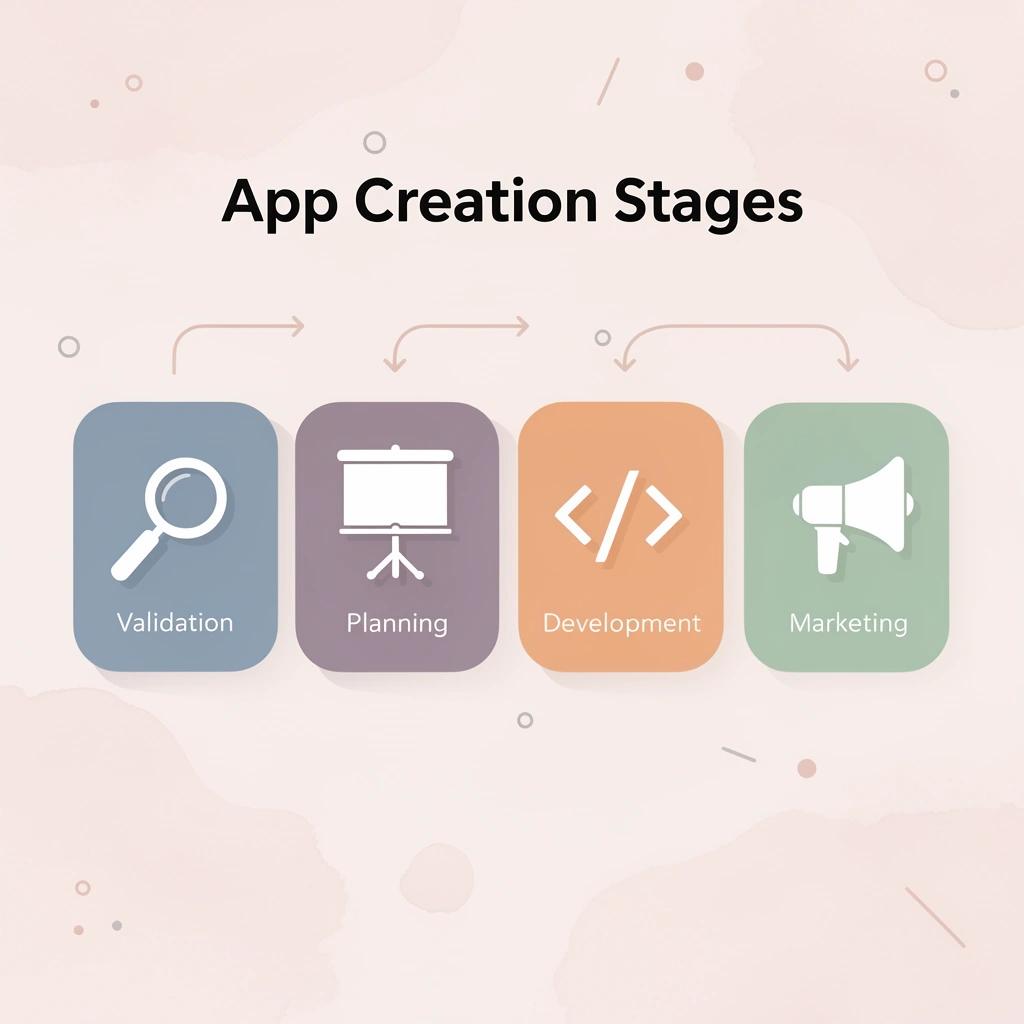
Product Development Stages
- Validation
- Key focus: Market research
- Success factor: Proof of user demand
- Planning
- Key focus: Strategy and design
- Success factor: Clear roadmap and execution plan
- Development
- Key focus: Building the product
- Success factor: High-quality execution and stability
- Marketing
- Key focus: User acquisition
- Success factor: Effective reach and conversion
- Operations
- Key focus: Ongoing management
- Success factor: Sustainable growth and retention
⚠️ Warning: Skipping the validation stage is the fastest way to build something nobody wants—no matter how technically perfect your code might be.
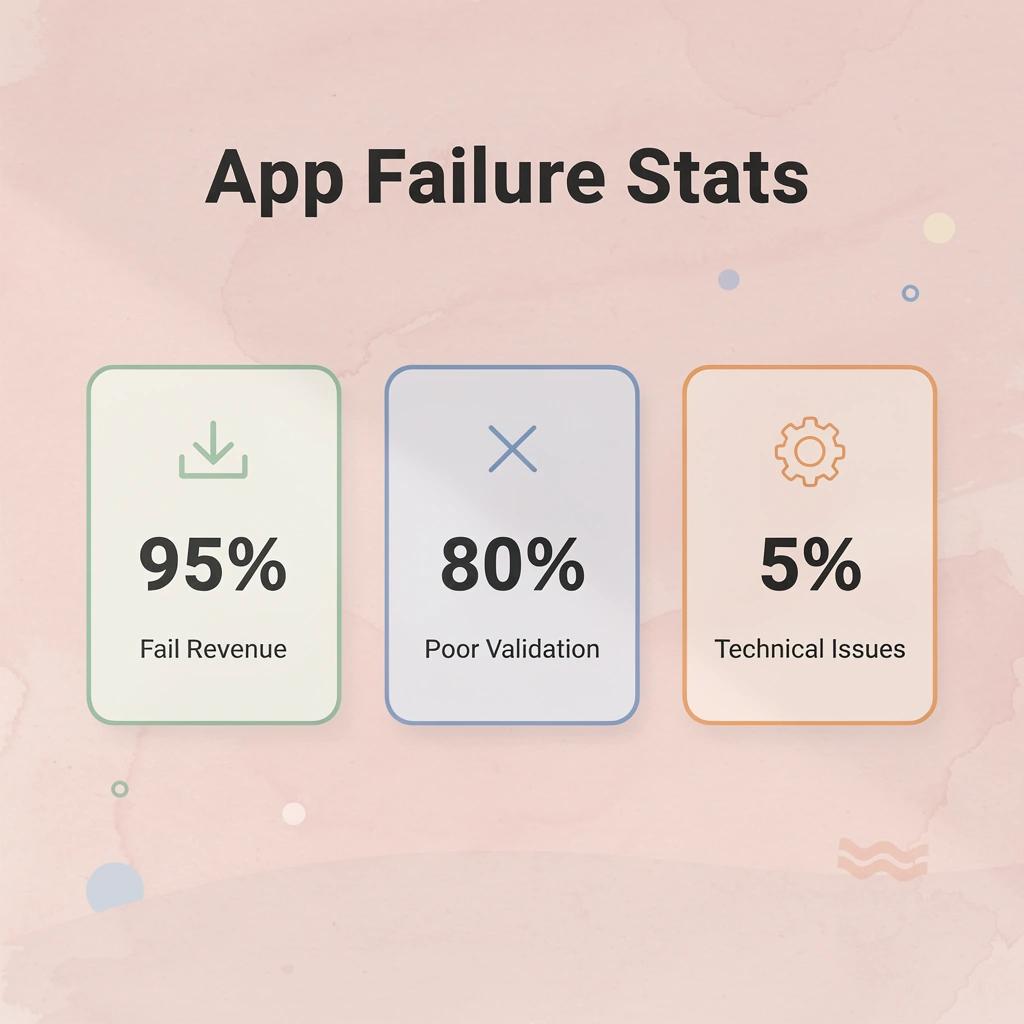
Idea Validation
Before writing code, you need evidence that people care about your problem. Identify your specific audience, understand their problems, and confirm they will act when a solution exists.
Skipping this step costs significant money. According to CB Insights' 2023 analysis of failed startups, 35% collapsed because they built products nobody wanted. Validation isn't about proving you can build something; it's about proving you should.
MVP Planning
Once demand looks promising, decide what to build first. Most first-time founders plan too many features before launch, resulting in months of additional work, delayed feedback, and increased complexity before anyone tests whether the core idea creates value.
Successful MVPs solve one problem exceptionally well, with everything else stripped away. The goal is learning, not impressing: reaching the moment when real users interact with your solution, and assumptions meet reality.
Development
After checking your plan and preparing, building transforms your idea into working software. This includes designing the interface, mapping user flows, connecting databases, implementing authentication, configuring infrastructure, and testing functionality.
Most founders see the launch as the finish line, assuming the real work of running and growing the business comes after the product succeeds. In reality, the work intensifies after launch. You're now managing real users, real feedback, and real business decisions while the product is live.
Marketing and Operations
Getting users is harder than building software. An app without customers is code. Distribution must be considered from the start: positioning, messaging, outreach, awareness, and traction. The most successful founders spend equal time on distribution and product because creating demand determines whether the business survives.
What operational challenges do founders face after launch?
Operations keeps everything running once users arrive: customer support, infrastructure management, product updates, performance monitoring, feedback collection, and growth initiatives. Solo founders balancing full-time jobs find this stage relentless.
How can founders avoid coordination bottlenecks?
Most founders think they need to hire developers, designers, and marketers to handle these stages separately. But as complexity grows, coordinating multiple people across validation, development, marketing, and operations creates bottlenecks: decisions slow down, costs multiply, and the gap between planning and execution widens.
Systems like Polsia collapse those stages into a single autonomous process that handles roadmap planning, code shipping, marketing execution, and customer management simultaneously, enabling founders to move from idea to launch without first assembling a team.
A Practical Framework for Creating an App
Creating an app is about building a business, not writing code. The goal is moving from idea to real market feedback as quickly as possible, not to a perfect product.

🎯 Key Point: The fastest path to success is getting your minimum viable product into users' hands and learning from real feedback rather than perfecting features in isolation.
The following framework helps first-time founders avoid common mistakes that keep app ideas stuck in the planning phase, prioritizing speed and validation over technical perfection.

💡 Pro Tip: Most successful apps launched with basic functionality and evolved based on user behavior—focus on solving one core problem exceptionally well before adding features.
"The biggest risk is not launching at all. Speed to market beats perfection every time when you're validating an app concept." — Lean Startup Methodology

Traditional Approach vs Framework Approach
- Development mindset
- Traditional approach: Perfect before launch
- Framework approach: Launch and iterate
- Product design
- Traditional approach: Feature-heavy
- Framework approach: Core problem focus
- Speed of execution
- Traditional approach: Months of planning
- Framework approach: Weeks to feedback
- Decision making
- Traditional approach: Assumption-based
- Framework approach: Data-driven decisionsStart With a Problem
Most unsuccessful apps start with a feature. Successful apps start with a problem. Before considering screens, functionality, or technology, identify a pain point people already experience. Ask yourself: What frustration am I solving? Who experiences this problem? How are they solving it today? Why are existing solutions inadequate?
The clearer the problem, the easier every future decision becomes. People pay for solutions to problems that matter, not for features.
Validate Before You Build
Validation should happen before development begins, not after launch. Gather evidence that potential users want your solution through customer interviews, industry communities, waitlists, surveys, competitor research, or pre-sales conversations. This reduces uncertainty before investing significant time and resources. The strongest app ideas rest on real demand, not personal assumptions.
Define a Simple MVP
First-time founders often overbuild, creating feature lists that attempt to solve every problem from day one, leading to delays, complexity, and unnecessary work. Instead, focus on the smallest useful version by asking: What is the core outcome users want? What is the minimum functionality required to deliver that outcome? Which features can wait? An MVP should solve one important problem effectively, not every problem.
Launch Quickly
Many founders wait for the perfect product before launching, but perfection is impossible to achieve alone. Real users provide insights that planning cannot. Launching early allows founders to test assumptions, identify usability issues, understand customer behavior, and learn what users value.
Learn and Improve
Launch starts the feedback cycle, not ends it. Once users interact with your product, you gain access to information far more valuable than assumptions. Pay close attention to user feedback, feature requests, usage patterns, objections, and retention behavior. The best product decisions are driven by what you observe rather than the founder's intuition. Refine the product based on users' needs.
Build Distribution Alongside the Product
One of the most common startup mistakes is assuming users will arrive after launch. Customer acquisition should begin long before the product is finished. Founders should consider distribution from the start by building an audience, creating content, joining relevant communities, running outreach campaigns, collecting email subscribers, or developing partnerships. Marketing is not an afterthought—it is part of building the business.
How can autonomous systems streamline app development?
The traditional approach involves hiring developers, designers, and marketers, then coordinating their work over months-long development cycles. As projects grow more complex, bottlenecks emerge: decision-making slows, communication overhead multiplies, and timelines stretch.
Systems like Polsia collapse those stages into a single autonomous process, handling roadmap planning, code shipping, marketing execution, and customer management simultaneously, enabling founders to move from idea to launch without first assembling a team.
Why does distribution often matter more than features?
According to App Builder, the low-code development market is expected to grow significantly by 2025, reflecting founders' increasing prioritization of speed and control over traditional development methods. A smaller product with strong distribution often outperforms a superior product that lacks market reach.
Creating an app is about reducing risk while learning more about customers and the market. Successful founders rarely build the most features first; they solve the clearest problem first.
Common Mistakes First-Time App Founders Make
Most failed apps don't fail because the founders aren't smart, motivated, or skilled; they fail because founders solve the wrong problems in the wrong order. These mistakes are predictable and avoidable.

🚨 Warning: The biggest trap for first-time founders is building features users think they want instead of solving problems users actually have. This leads to feature bloat and poor user retention.
"70% of startups fail not because of competition or funding, but because they build products nobody wants." — CB Insights Startup Failure Report, 2023

💡 Key Insight: Successful app founders focus on one core problem first, validate it with real users, and resist the urge to add unnecessary complexity until they've achieved product-market fit.
Spending Months Building Before Validating
Excited founders often spend months developing features before talking with potential users or testing whether people want what they're making. If the underlying problem isn't important to customers, all that development work may create an unwanted product.
According to CB Insights' analysis of startup failures, 35% cited "no market need" as a reason for failure. Validation would have been faster and cheaper than building.
Trying to Launch With Too Many Features
First-time founders often imagine an app solving every possible problem for every user, resulting in bloated feature lists, extended timelines, and complexity that obscures what users value.
A simple product that solves one problem effectively generates better feedback than a complex product that addresses ten problems. Successful founders think in terms of minimum viable products; unsuccessful ones think in terms of maximum feature lists.
Why do many apps fail to find users?
Many founders assume users will arrive at launch, but great products rarely market themselves. Acquiring customers is often the hardest part of building a software business. Yet many first-time founders spend nearly all their time on development and almost none on distribution.
What happens when founders focus only on building?
A founder spends six months building a productivity app with polished onboarding and professional design. But there's no audience, email list, content strategy, outreach plan, or acquisition channel. The app works, but growth never happens.
Separating building and marketing into sequential phases creates a painful gap: the product launches, but nobody knows it exists, and by the time founders realize they need distribution, months of runway have burned. Platforms like web app development companies address this by handling both product development and go-to-market execution simultaneously, compressing the gap between building and acquiring users while founders maintain strategic control.
Waiting for Perfect Conditions
Many app ideas remain stuck in planning because founders wait for perfect conditions: more experience, savings, confidence, or certainty. But startups are inherently uncertain, and there's always another feature to add or skill to learn.
Founders who make progress launch before feeling fully ready. Real-world feedback is more valuable than endless preparation.
Underestimating Operational Workload After Launch
Many founders treat launch as the finish line when it's the starting line. Once users arrive, they must handle customer support, infrastructure maintenance, product updates, user feedback, marketing, and growth initiatives—a workload that surprises most first-time founders.
According to research from RetentionAdam, most first-time founders hire too early, often before reaching $1 million in annual recurring revenue, when the operational burden doesn't justify the cost and complexity of managing people. The real challenge isn't volume: it's constant context switching between product, support, marketing, and infrastructure that fragments attention and slows progress.
The Bigger Lesson
If you look closely at these mistakes, a pattern emerges: few are technical—they're business problems. Validation problems. Marketing problems. Operational problems. This is why many founders discover that building software is only one piece of the puzzle.
But knowing what not to do leaves a harder question: how do you do it right?
Related Reading
- Softr Alternatives
- Replit Alternatives
- Mobile App Ideas
- Appsheet Alternatives
- Devin Ai
- Ai Tools For Product Managers
How Polsia Helps First-Time Founders Create and Run an App
Most first-time founders fail not because they lack a vision, but because they cannot execute across product strategy, software development, marketing, customer management, and operations. Traditionally, this required months of team-building, fundraising, or learning to code. Polsia removes these dependencies by handling the operational layer of running a company.

🎯 Key Point: Polsia eliminates the traditional barriers that prevent first-time founders from launching their app ideas by providing end-to-end operational support.
"Most startups fail because founders spend too much time on operational tasks instead of focusing on product-market fit and customer validation." — Startup Failure Research, 2023

💡 Tip: Instead of spending months learning technical skills or raising initial capital, first-time founders can leverage Polsia's platform to focus on what truly matters: validating their idea and building customer relationships.
What makes translating concepts into business plans so challenging?
The hardest part of starting your own business isn't coming up with ideas—it's determining what matters and what to build first. A founder might see a clear problem but struggle to translate it into positioning, feature prioritization, pricing strategy, or a realistic go-to-market approach. Without structure, months can disappear into analysis paralysis or misdirected building.
How does Polsia help founders bridge the strategy gap?
Polsia addresses this by independently creating actionable business plans. Rather than leaving founders to extract strategy from blog posts and startup podcasts, it transforms raw ideas into structured roadmaps with defined milestones. This proves especially valuable for first-time founders, where the gap between "I see the problem" and "here's how we solve it profitably" can feel impossibly wide.
Why don't you need a technical team to create an app?
Many people believe creating an app requires hiring developers or finding a technical co-founder, a misconception that has prevented thousands of viable business ideas from launching. Polsia eliminates this barrier by handling all development work, transforming wireframes into working software. Founders no longer need to learn React, manage freelancers on Upwork, or negotiate equity splits with technical co-founders.
How fast can you build and scale without developers?
According to Context Studios' Blog's Polsia case study, a solo founder reached $1M in ARR in 30 days by automating development, marketing, and operations simultaneously. This speed is impossible when coordinating multiple people. Polsia treats business functions as connected systems operating in parallel rather than sequentially.
Deployment and Infrastructure Management
Launching software requires more than writing code: infrastructure must be set up, environments deployed, systems monitored, and security protocols implemented.
For non-technical founders, these requirements often prevent finished products from reaching users. The gap between "the app works on my laptop" and "customers can reliably access this" involves technical complexity that feels insurmountable without an engineering background.
Polsia manages infrastructure and deployment processes, reducing the operational burden that typically requires dedicated DevOps expertise. Founders can focus on refining the product and serving customers instead of troubleshooting server configurations or debugging deployment pipelines.
Why do most apps struggle with user acquisition?
Most apps fail not because the product is poor quality, but because nobody knows they exist. Founders lack the skills to reach potential users.
Marketing is where first-time founders struggle most. They launch their product successfully but lack a system to reach more people, so growth stalls despite the product's quality.
How can automated systems solve customer acquisition challenges?
Polsia runs automated marketing across multiple channels, including cold email outreach, Meta advertising, and social media, treating customer acquisition as an operational system rather than a periodic campaign.
According to Henry's Best Hits on Substack, over 6,000 companies now use AI systems to handle functions that traditionally required full teams. Distribution occurs continuously in the background, freeing founders to focus on product decisions and customer conversations that require human judgment.
Managing Communication and Support at Scale
As businesses grow, customer communication becomes an operational challenge in its own right. Prospective customers ask questions, current customers need support, and sales conversations require follow-up. Managing these interactions manually consumes significant time.
Polsia automates customer support and inbox management so communication doesn't become a bottleneck. Founders stay responsive without spending hours answering repetitive questions or sorting through support tickets. The system handles routine interactions while routing complex issues requiring human decision-making to the appropriate person.
But what does it look like to start using Polsia?
Related Reading
- Best Mobile App Builder
- No Code Ai Tools
- Hire App Developer
- Mobile App Ideas
- Ai App Builders
- Lovable Ai
- Best Vibe Coding Tools
Start or Grow your Existing Business with Polsia Today
If you've been waiting for the right moment to start, you've already waited long enough. The tools exist now to turn ideas into working businesses without assembling a team or learning to code.

🎯 Key Point: Success starts with crystal-clear problem definition and target customer identification.
Start by being clear about the problem you're solving and who needs it solved. Write down the specific frustration your app addresses and the exact type of person who experiences that pain every day. Polsia transforms that clarity into a complete business operation, handling roadmap planning, software development, marketing execution, and customer support, so you can focus on decisions only a founder can make.
"The best time to plant a tree was 20 years ago. The second best time is now." — Chinese Proverb
💡 Tip: Your technical background matters less than your market understanding and execution speed.
You don't need permission, investors, co-founders, or a technical background. You need a problem worth solving and the willingness to put something into the market that real people can use. What used to require months of hiring and coordination now starts tonight.