How to Start an AI Company: A Guide for First-Time Founders

Starting an AI company involves far more than a good idea. Founders face a long list of decisions: validating the concept, building a product, and landing paying customers, often without a technical background or a large budget. For non-technical founders, the best no-code SaaS builder approach has become a practical way to launch an AI startup without assembling a full engineering team from the start.
Moving from concept to a working product requires more than tools; it requires a clear process. Founders who skip straight to building often waste time on features users do not want, while those who validate early move faster and spend less. For founders ready to build with intention, Polsia is a web app development company that helps turn AI business ideas into real, functional products without getting lost in code.
Table of Contents
- Why So Many Founders Are Entering the AI Market
- What Does an AI Company Actually Need to Succeed?
- How to Start an AI Company Step by Step
- Common Mistakes New AI Founders Make
- How AI Startups Can Scale Faster Than Traditional Businesses
- How Polsia Helps Entrepreneurs Start and Scale AI Companies
- Start or Grow Your Existing Business with Polsia Today
Summary
- AI tools have fundamentally changed who can start a company and how fast. Solo founders drove nearly all of the growth in startup formation in recent years, according to Apollo The Daily Spark, because the cost of testing an idea has compressed from months and hundreds of thousands of dollars to days and minimal capital. The old argument for waiting until you have co-founders or early hires has lost most of its weight.
- The failure rate in AI is not a technology problem. Gartner data (via Mission Cloud) shows that 74% of AI projects fail to meet their objectives, most often because teams skipped confirming the problem was worth solving before building. Customer validation before writing a single line of code is the step that separates founders who ship from founders who succeed.
- Positioning is a more durable competitive advantage than the technology itself. McKinsey (via Mission Cloud) reports that only 1% of business leaders describe their companies as mature in AI deployment, meaning the market is still early and still forming opinions about what good looks like. Founders who clearly and specifically define their category right now earn a positioning advantage that compounds before the space fills with indistinguishable options.
- AI startups have structurally inverted the traditional scaling sequence. According to Decidr.ai's 2025 business growth research, AI-powered businesses can scale 3x faster than traditional businesses, not because they work harder, but because they eliminate entire categories of operational delays that slow traditional businesses at every stage of growth.
- Keeping costs lean early is not just frugality. It is a strategic decision about how long a founder can stay in the game. PwC's 2026 AI Business Predictions report that companies adopting AI at scale can reduce operational costs by up to 30%, which, for an early-stage startup, translates directly into extended runway and more iterations before capital runs out.
- Delaying launch for a more polished product is one of the most consistent and costly mistakes in early-stage AI. Founders who ship early and iterate based on real user behavior consistently outpace those who optimize in private, because the first version does not need to be impressive; it needs to generate the feedback that makes the second version worth building. Polsia, a web app development company, addresses this by enabling solo founders to plan, build, and market a product without first assembling a team, so the bottleneck becomes the decision to start rather than the capacity to execute.
Why So Many Founders Are Entering the AI Market
The timing has never been better for first-time founders. According to Apollo The Daily Spark, AI tools are making it easier for individuals to start businesses independently, driving a surge in entrepreneurs. Previously, launching required capital, a technical co-founder, and months of savings before a working product could be demonstrated.
"AI tools are making it easier for individuals to start businesses on their own, leading to a big increase in the number of entrepreneurs." — Apollo The Daily Spark
🎯 Key Point: The barriers to entry that once blocked first-time founders—capital, technical co-founders, and long runways—are being dismantled by AI.

What changed is the cost of making a mistake. When building a prototype took six months and $200,000, the founders needed certainty before taking action. Now, testing an idea happens in days. That faster way of testing ideas is bringing more people into the market: the downside of trying has become negligible.
💡 Tip: If you've been waiting for the right moment to test your idea, that moment is now. The time and cost barriers that once made experimentation impossible have collapsed.
🔑 Takeaway: The shift from $200,000 and six months to days and near-zero cost isn't a convenience—it's a fundamental change in who gets to be a founder.
Why is the solo founder path more viable than ever before?
Apollo The Daily Spark reports that solo founders drove nearly all growth in startup formation in recent years. When a single person with a clear problem and the right tools can build, market, and operate a product without assembling a team, the traditional argument for waiting until you have co-founders weakens. The bottleneck is no longer the number of people: it is the decision to start.
Most aspiring founders still approach this the old way: sketch the idea, plan the team, budget the salaries, and then wonder why momentum stalls before the product exists. The familiar path treats hiring as something you need to do before building, an assumption that quietly kills more startups before launch than any technical challenge. A web app development company like Polsia removes that friction entirely, giving solo founders an independent system that handles planning, coding, marketing, and operations without requiring a single hire to get started.
What shifted the underlying economics of starting an AI company?
The AI market is growing because how companies start has changed. Industries that once required large technical teams—healthcare, logistics, and financial services—are now accessible to founders who deeply understand customer problems, even without engineering backgrounds. Domain expertise is becoming more valuable than a computer science degree.
This openness has advantages and disadvantages. It's easier to enter the market, but harder to stand out. The real question is not whether you can start an AI company, but whether you understand what makes one succeed after launch.
Related Reading
- Best No Code SaaS Builder
- How To Turn An Idea Into A Product
- Startup Product Development
- How To Automate My Business
- How To Start A Software Company
- How To Create A Digital Product
- How To Find A Cofounder
- How To Start an AI Company
- How To Start A Saas Business
What Does an AI Company Actually Need to Succeed?
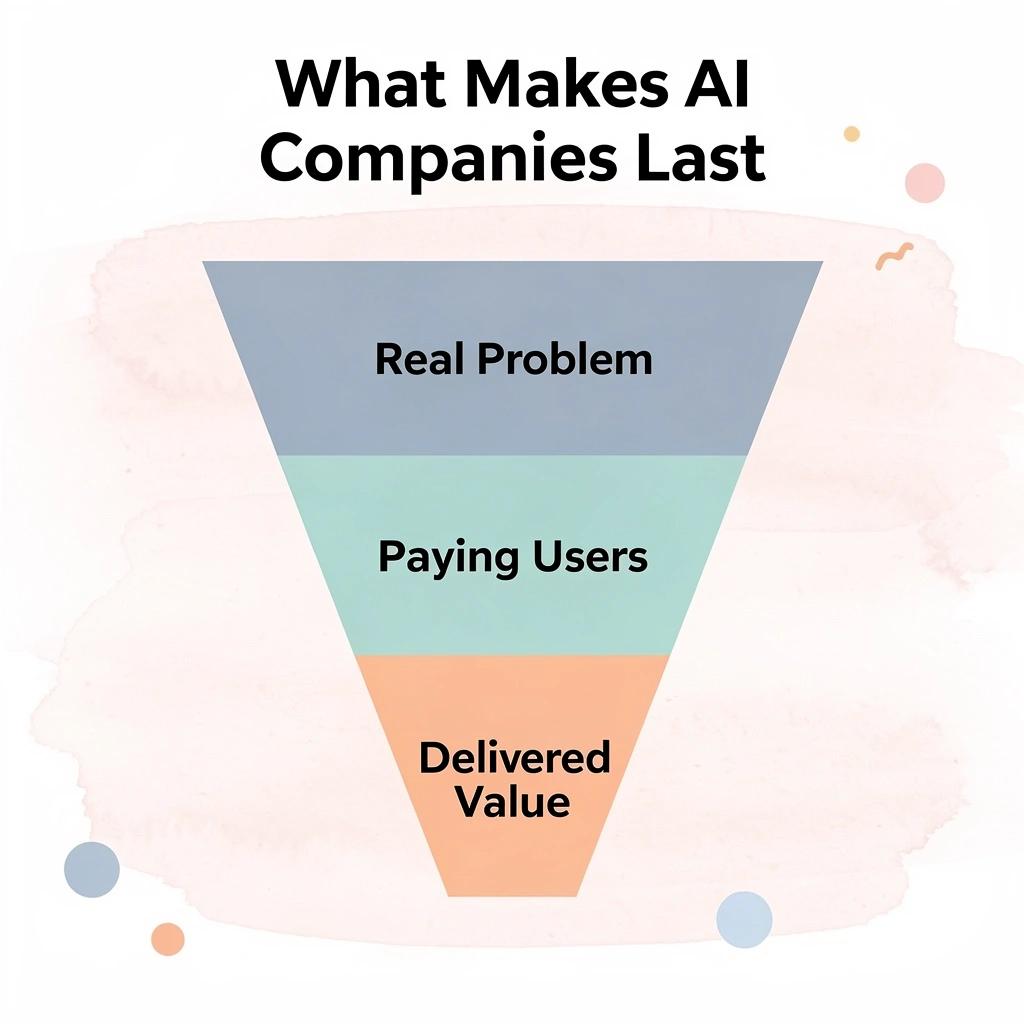
Doing well in the AI industry depends less on how advanced a model is than on solving a clear problem. The companies that last aren't those with the most impressive demos — they're the ones that found a real problem, confirmed people would pay to solve it, and delivered on that promise.
"The companies that last aren't those with the most impressive demos — they're the ones that found a real problem, confirmed people would pay to solve it, and delivered on that promise."
Building a successful product requires prioritizing utility and validation over technical spectacle:
- Product Focus: Ditch impressive demos with no clear use case in favor of solving a specific, validated problem.
- Performance: Stop chasing the most advanced model and start delivering on a clear, consistent promise.
- Strategy: Quit building first and finding users later; confirm that people will pay for your solution first.🎯 Key Point: The real competitive edge in AI isn't technical sophistication — it's problem clarity and the ability to prove someone will pay for the solution
💡 Tip: Before investing in model performance, validate that your target users have a genuine, urgent problem and are actively looking for a solution they'd pay to fix.
Why do most AI projects fail before they start?
According to Gartner (via Mission Cloud), 74% of AI projects fail to meet their goals, not because of bad technology, but because teams skipped validating that the problem was worth solving. A technically impressive product built on untested assumptions remains a product nobody wants.
What does customer validation actually reveal?
Customer validation separates founders who ship from founders who succeed. Speaking directly to ten potential customers before writing code reveals more than six months of internal planning. Listen for specific frustrations someone has tried to fix but failed to—that's where real willingness to pay lies.
How does building too early cost solo founders?
Most solo founders build first and ask questions later because building feels like progress. The cost: months of creating something polished only to discover the market needed something different. A web app development company like Polsia closes that gap, moving founders from a validated idea to a working product without having to assemble a team to test a hypothesis.
Why positioning is the real competitive advantage
The critical difference between AI companies that grow and those that stall is rarely the technology—it's how clearly they communicate who they help and what outcome they deliver. "AI platform" is not a position. "Reduces customer service costs for e-commerce stores by automating tier-one support" is a position. One makes a buyer lean in. The other makes them scroll past.
Why does early category definition compound into lasting revenue?
McKinsey (via Mission Cloud) reports that only 1% of business leaders describe their companies as mature in AI deployment. The market remains early, with leaders still forming opinions on what constitutes excellence. Founders who define their category clearly now, before options proliferate and blur together, gain a positioning advantage that compounds over time. Execution and specificity convert that advantage into revenue.
Knowing what your company needs to succeed is one thing. Knowing the exact sequence of moves from idea to operating business is where most founders encounter real friction.
How to Start an AI Company Step by Step
Sequence is where most founders lose time. You can validate a problem and define an audience, then stall for months because the steps seem to require a full team. They don't.
"The biggest mistake early-stage AI founders make is waiting for the perfect team before taking the next step — momentum is built by individuals, not committees." — Startup Sequencing Insight
💡 Tip: You don't need a full team to move forward — solo founders can validate, build, and launch an MVP faster than most multi-person teams bogged down by decision overhead.
⚠️ Warning: Stalling between steps is the #1 momentum killer for early AI startups. If a step feels like it requires more people, break it into smaller actions you can execute today.
Founders often overcomplicate their path to launch by assuming they need more resources than they actually do:
- Problem Validation: You don't need a research team; you need one honest conversation with a target user.
- Audience Definition: You don't need a marketing hire; you need a sharp one-liner and a defined niche.
- MVP Build: You don't need a full engineering team; you need a single no-code or AI-assisted prototype.
- First Customer: You don't need a sales team; you need one effective direct outreach message.

Where the actual work begins
Start with the problem, not the product. Spend your first week talking to ten real people in the industry you want to serve. Those conversations reveal whether the pain is urgent enough that people will pay for it—the only question that matters before anything gets built. A competitive market signals demand, not hesitation.
How do you define the right problem before building anything?
Once you've confirmed the problem is real, identify who feels it most strongly. Pick a specific role, company size, and frustration level, then build the smallest possible version that addresses exactly that need. An MVP is not a half-finished product; it is a precise answer to a narrow question, launched fast enough to learn from real behavior rather than assumptions.
What removes the overhead that slows most founders down?
Most founders assume they'll need a developer, marketer, and operations person before shipping. That assumption stretches timelines from weeks to years. A web app development company like Polsia removes that dependency, enabling solo founders to plan, build, and market a product without first assembling a team. The bottleneck was never the idea; it was always the overhead required to act on it.
What actually drives early revenue
According to elev-x, AI startups raised over $100 billion in venture capital in 2024. The market lacks specificity, not capital. Investors and customers reward founders who identify the exact problem, exact customer, and exact solution their product delivers. Vague AI tools get ignored; precise ones get bought.
How does your pricing model affect whether customers actually pay?
Match your business model to how your customers think about spending. A small business owner responds differently to usage-based pricing than an enterprise procurement team does to an annual contract. Getting this wrong means building a product people like but won't pay for.
The path from validated idea to first paying customer is shorter than most founders expect.
Common Mistakes New AI Founders Make
Most AI startups fail not because the technology breaks, but because founders keep building when they should listen, keep adding features when they should ship, and treat the product as the company when the company is the system around it.
"Most AI startups fail not because the technology breaks, but because founders mistake building for progress." — A pattern seen across early-stage AI ventures
⚠️ Warning: If you're still building when you should be listening, you're not making progress—you're making technical debt.
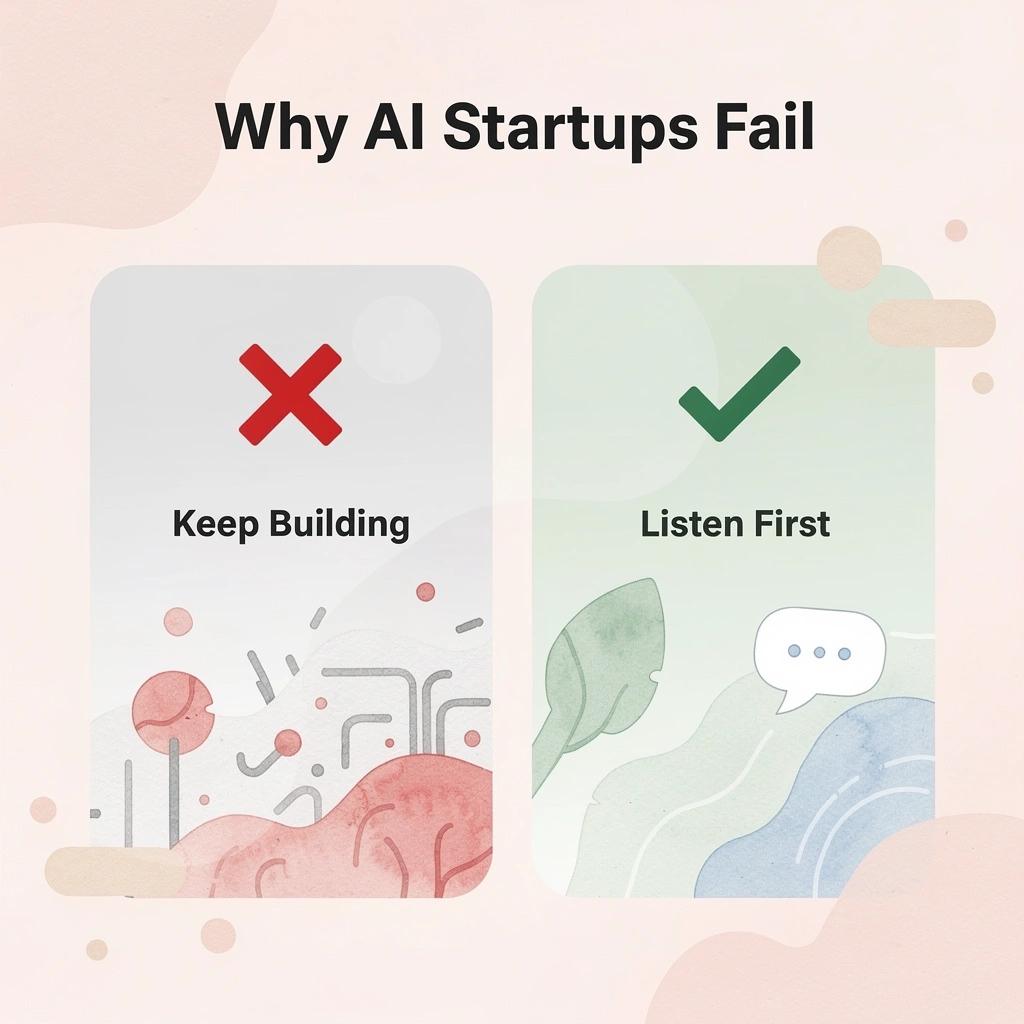
New founders get excited about AI capabilities and mistake that excitement for actual market demand. They build platforms packed with analytics, authentication, and payment flows before checking if anyone actually wants the core thing. Founders treat complexity as a sign of value when markets consistently reward precision over breadth.
💡 Tip: Before building your second feature, confirm that real users are getting undeniable value from your first.
Successful founders distinguish themselves by prioritizing market-validated outcomes over technical complexity:
- Product Scope: Focus on solving one problem completely rather than building five features poorly.
- Value Perception: Recognize that precision and focus—not complexity—are the true proxies for value.
- Launch Priorities: Validate core demand first instead of getting distracted by building analytics, auth, or payment systems.
- Validation: Rely on actual user behavior as a market signal rather than mistaking excitement for genuine intent.🎯 Key Point: The product that solves one problem completely always beats the product that solves five problems poorly.
When the tool becomes the pitch
Positioning AI as the product rather than the tool is one of the most consistent mistakes across early-stage AI companies. Customers don't buy machine learning models; they buy results: faster decisions, lower costs, fewer errors. The technology should be invisible, like a good engine inside a car you trust.
Why do solo founders hit a wall before growth even starts?
Most early-stage founders handle operations manually and reactively—answering support tickets, chasing invoices, scheduling demos, and writing marketing copy between coding sessions. This approach breaks down quickly. A web app development company like Polsia is built for this moment. Our platform gives solo founders a system that handles planning, development, marketing, and operations in parallel, so the bottleneck becomes the decision to start, not the capacity to execute.
What happens when AI pilots stall without operational infrastructure?
According to an MIT report cited by Anastasiia S. on LinkedIn, 95% of generative AI pilots fail because companies cannot integrate AI into real workflows. The gap isn't about bad ideas—it's the distance between what a tool can do on its own and what it can do within a business that lacks the supporting systems. Founders who skip building proper operations early face consequences when growth arrives, and small problems escalate.
What perfectionism actually costs
Delaying launch for a better version is the most socially acceptable way to avoid the market. It feels like careful work. It reads like discipline. But waiting for a polished product delays the only feedback that matters: a real person with a real problem deciding whether your solution is worth their money. The founders who ship early, learn fast, and iterate with user input consistently outpace those who optimize in private. The first version doesn't need to be impressive. It needs to be honest.
Once you stop treating headcount as the solution to growth, the entire model of scaling looks different.
How AI Startups Can Scale Faster Than Traditional Businesses
Growing a traditional business meant spending money before making money. You hired people, then built things, then hoped customers would come. AI startups have completely flipped that order — and the difference in outcomes is staggering.
"AI-powered businesses can grow 3 times faster than traditional businesses." — Decidr.ai, 2025
🎯 Key Point: The old model of spend first, earn later is being replaced by AI-driven growth engines that generate value before headcount scales.
The shift from traditional operations to an AI-driven startup model fundamentally changes how you scale:
- Hiring Strategy: Move from "hire first" to building systems first and hiring only when strategically necessary.
- Operations: Transition from manual, training-heavy tasks to automated systems running 24/7.
- Scalability: Break the link between growth and headcount, allowing expansion to be limited only by market size.
- Cost Structure: Swap high upfront labor costs for a low marginal cost model that scales efficiently.
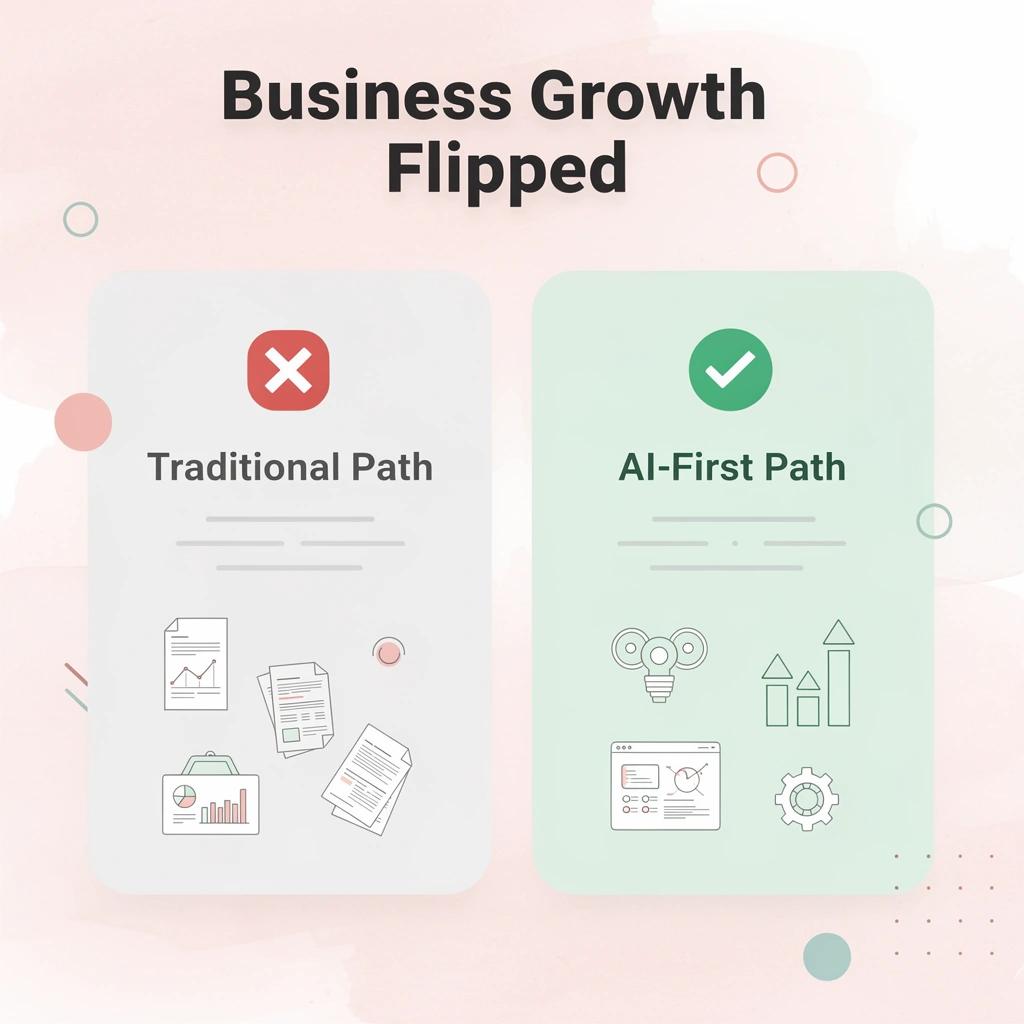
According to Decidr.ai's 2025 business growth research, AI-powered businesses can grow 3 times faster than traditional businesses. When your main operations run on systems that work continuously, require no training, and incur no labor costs, your business growth accelerates significantly.
💡 Tip: Focus your early investment on building AI-driven core operations. Systems that never sleep are your most powerful scaling advantage.
🔑 Takeaway: A 3x growth advantage isn't marginal—it's the difference between surviving and dominating your market. AI startups operate under fundamentally different rules than traditional businesses.
Where the structural advantage actually lives
The critical difference is that AI startups eliminate entire categories of delay. Customer support lines, content backlogs, lead-qualification bottlenecks, and reporting cycles: these friction points slow traditional businesses at every growth stage. When those functions run autonomously, the founder's attention stays on work that drives revenue. Most early-stage teams spend the majority of their time managing operations rather than building product or talking to customers. AI flips that ratio.
What happens when you plan to hire your way out of bottlenecks?
Most founders plan to hire their way out of bottlenecks, but each hire introduces coordination overhead, onboarding time, and fixed costs that compound before revenue does. A web app development company like Polsia removes that ceiling entirely, giving solo founders the operational capacity of a team without the structural weight. The bottleneck becomes clarity of direction instead of headcount.
What lower costs actually unlock
PwC's 2026 AI Business Predictions report that companies using AI at scale can reduce operational costs by up to 30%. For early-stage startups, this extends runway: more time to find the right product before capital depletes. Founders who maintain low costs can test more ideas longer and discover product-market fit before competitors exhaust resources and are forced to pivot or shut down.
A lean, AI-powered operation that releases new versions every two weeks will learn faster than a traditionally staffed team that releases every two months. This stems not from superior talent, but from shorter feedback loops and lower costs for mistakes. That difference is where the real scaling advantage lies, and it's available from day one.
The hardest part was never the tools.
Related Reading
- Ai Prototyping
- Mvp Tools
- Replit Alternatives
- Best App Creators
- Best Ai Tools For Startups
- Lovable Ai Alternatives
- Softr Alternatives
- Easiest Way To Build A Web App
- Bolt Alternatives
- Saas Mvp Development
- No-Code AI Tools
- Bubble.io Alternatives
How Polsia Helps Entrepreneurs Start and Scale AI Companies
Learning how to start an AI company is one thing. Successfully executing that plan is where founders run into the biggest challenges. The distance between knowing the steps and completing them is where most entrepreneurial ambitions stall.
"The gap between planning and execution is where most startups fail — not from lack of ideas, but from lack of action." — Startup Ecosystem Insight
🎯 Key Point: Understanding how to build an AI company and actually building one are two entirely different challenges. Execution is the critical variable most founders underestimate.
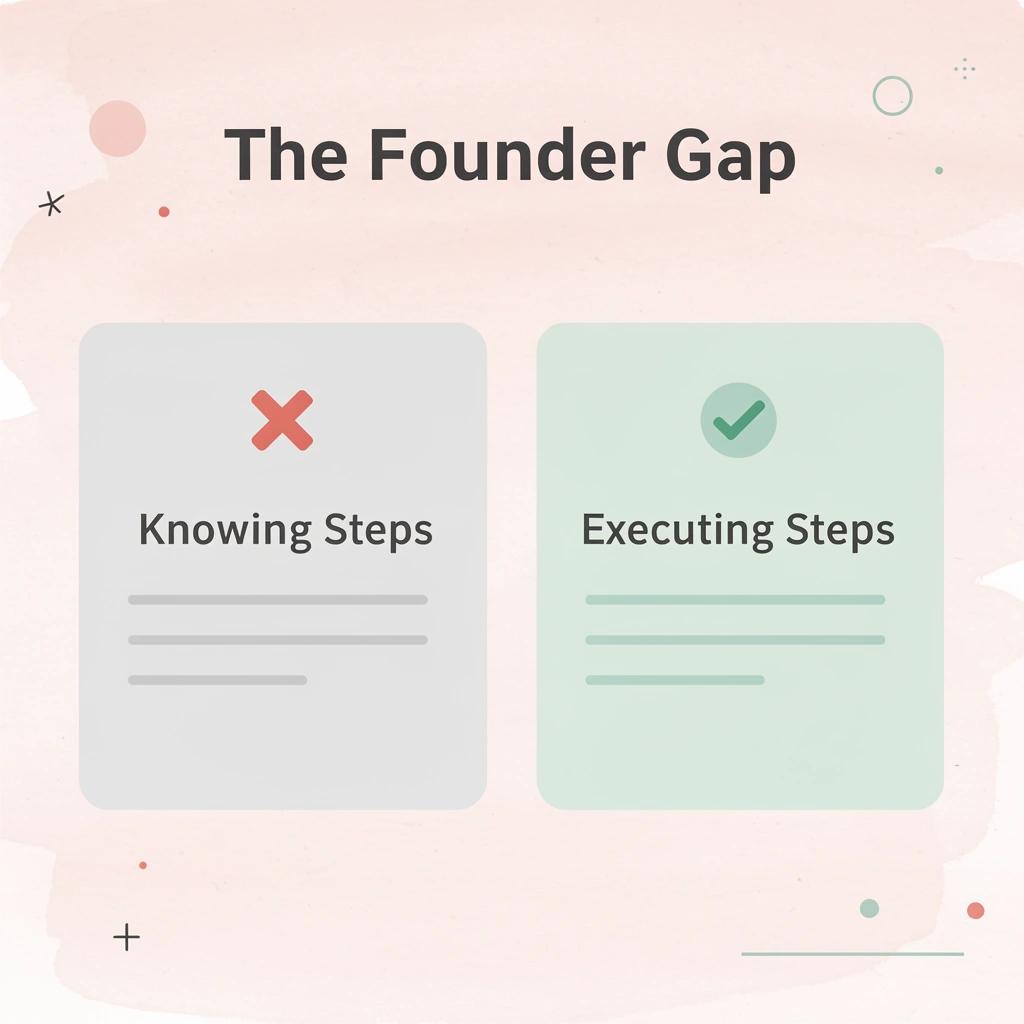
Many aspiring entrepreneurs understand the basics of validating ideas, building products, getting customers, and scaling businesses. However, turning those steps into real action is hard — especially for first-time founders who lack technical expertise, business experience, or the resources to hire large teams. The result is a painful gap between knowing what to do and having the capacity to do it.
⚠️ Warning: First-time founders without technical backgrounds are most vulnerable to getting stuck at the execution stage — where ideas stall and momentum dies.
Founders often face significant roadblocks when scaling alone, but identifying these friction points early is the first step toward overcoming them:
- Lack of technical expertise: Limits your ability to independently build or evaluate AI products.
- Limited business experience: Impedes your go-to-market strategy and customer acquisition.
- No resources for large teams: Causes critical tasks to stall or go unfinished.
- Overwhelm from competing priorities: Results in a loss of focus and early momentum.
Polsia bridges the gap between planning and execution by functioning as an autonomous AI co-founder. Rather than providing advice, Polsia helps founders execute many of the tasks required to build and grow a company, acting as a true operational partner, not just a tool. This enables faster progress, fewer bottlenecks, and a lower barrier to launching and scaling an AI business.
💡 Tip: Think of Polsia not as a passive advisor, but as an active co-founder who helps you move from strategy to execution without needing a large team or deep technical background.
🔑 Takeaway: Polsia's autonomous co-founder model solves the #1 problem facing early-stage entrepreneurs: turning ambitious plans into real, measurable business results.

How does Polsia help with planning and validating a business idea?
One of the first challenges new founders face is business planning. A promising idea requires a clear strategy, market positioning, and execution plan. Polsia helps entrepreneurs organize ideas, evaluate opportunities, and create actionable paths toward launching a business.
Before building a product, founders must understand whether there is real demand for what they want to create. Polsia helps with market research and validation, enabling entrepreneurs to understand their target audience, competitive landscape, and potential opportunities before investing significant time and resources into development.
How does Polsia support product development and getting to market faster?
Once an opportunity has been validated, building the product becomes the next major challenge. Traditionally, launching a software company required development teams, designers, infrastructure specialists, and significant technical knowledge. Polsia simplifies this through full-stack product development capabilities that support the creation of software products, web applications, and online businesses.
For many startups, speed matters. Rather than spending months or years developing a product, founders benefit from launching quickly and gathering feedback from real users. Polsia supports MVP creation and deployment, helping entrepreneurs bring ideas to market faster so they can validate assumptions and acquire customers.
How does Polsia help founders grow and manage their business operations?
Building a product is only one part of building a company. Growth requires visibility and customer acquisition. Our platform automates marketing activities across multiple channels, including cold email outreach, Meta advertising, and social media marketing, enabling founders to generate demand without manually managing every campaign.
As customer interest grows, communication becomes increasingly important. Our platform streamlines customer communication and inbox management, enabling founders to stay engaged with prospects and customers while maintaining operational efficiency.
Polsia assists with infrastructure setup and operational management, helping founders establish the processes and technical environments necessary to run and scale their businesses.
Why is Polsia especially valuable for first-time founders with limited experience?
One of Polsia's most significant advantages is its 24/7 execution capabilities. Entrepreneurs need neither large teams nor advanced technical skills to build a company, making the platform particularly valuable for first-time founders with strong ideas but limited experience.
Polsia supports the entire journey: business planning, market validation, product development, marketing, customer management, and operations. For aspiring founders building AI companies, the challenge is rarely a lack of ideas. By automating and accelerating startup launch and growth activities, Polsia enables entrepreneurs to focus on building businesses rather than managing every technical and operational challenge alone.
Start or Grow Your Existing Business with Polsia Today
The hardest part was never the tools or the idea: it was deciding you are enough to start. If you're ready to plan, build, launch, and grow an AI company without assembling a team first, our web app development company enables you to do exactly that, from your first line of product logic to your first paying customer.
"The bottleneck is no longer the number of people on your team—it's simply the decision to begin." — Polsia
🎯 Key Point: You don't need a full founding team to launch a serious AI product. Solo founders now have access to tools that replace entire departments.
💡 Tip: Start with one core product idea and let Polsia handle the rest, from development to go-to-market strategy. The fastest path to your first customer begins today.

Polsia works as your independent AI co-founder, handling product planning, development, marketing, and daily operations—all in one place. You no longer need to hire a developer, marketer, or operations manager before you can move forward. The bottleneck is no longer the number of people—it's simply the decision to begin.
Polsia serves as an all-in-one partner for your business development:
- Product Planning: Provides a clear roadmap to take your concept from idea to launch.
- Development: Allows you to build your app without hiring an internal tech team.
- Marketing: Accelerates your ability to reach and acquire your first paying customers.
- Daily Operations: Enables you to run a lean business model with zero overhead.
✅ Best Practice: Treat Polsia as a co-founder, not just a tool. The founders who move fastest are those who fully delegate planning, building, and growing to the platform from day one.
Related Reading
- Base44 Vs Lovable Ai
- Bubble.io Vs Webflow
- Bolt Vs Replit
- Glide Alternatives
- Bubble Vs Lovable
- Replit Vs Base44
- Glide Vs Bubble
- Lovable Ai Vs Replit