10 Best AI App Builders for Non-Technical Founders
Brilliant app ideas often get stuck in the planning phase when founders face the reality of coding complexity. AI app builders now eliminate this barrier by transforming natural language descriptions into functional applications. These platforms use intelligent code generation, drag-and-drop interfaces, and automated workflows to help non-technical entrepreneurs build mobile apps and web applications without years of programming study.
Modern AI-powered development tools range from complete no-code solutions to sophisticated low-code platforms that accelerate professional development. Choosing the right approach depends on factors like project complexity, scalability requirements, and long-term maintenance needs. For founders seeking expert guidance through this landscape, partnering with an experienced web app development company ensures the selected tools and development strategy align with specific business goals and technical requirements.
Table of Contents
- Why Building an App Is Easier Than Building a Business
- What Most AI App Builders Actually Help You Do
- 10 Best AI App Builders
- Why Most Founders Get Stuck After the MVP
- What Founders Actually Need Beyond an AI App Builder
- How Polsia Helps Founders Build and Operate a Business
- Start or Grow your Existing Business with Polsia Today
Summary
- AI app builders have collapsed the technical barrier that once stopped non-technical founders from launching software companies. According to Business News Daily, 42% of small businesses now have mobile apps, a figure that would have been unthinkable a decade ago when development required specialized technical skills or significant capital. The shift means that for the first time in software history, the hardest part of starting a tech company isn't the technology. It's everything that happens after you ship.
- Most AI app builders focus on solving one specific problem: creating software faster. Users report 10x faster development with AI-assisted platforms compared to traditional coding. Apps built with these tools have been downloaded over 2 million times across major app stores, demonstrating that these platforms can produce real, market-ready products. The constraint isn't production capacity anymore. It's attention, trust, and the ability to consistently attract customers who will actually pay for what you've built.
- Customer acquisition remains one of the least understood aspects of entrepreneurship among first-time founders. Research from Startup Genome shows that 70% of startups scale prematurely, often investing heavily in product development before establishing sustainable customer acquisition and market demand. A mediocre product with effective distribution can outperform a superior product that nobody discovers, yet founders typically spend months building features and weeks thinking about customers.
- Zapier reports that 80% of AI app builders focus on creating internal tools, dashboards, and CRUD applications. The Reflex Blog notes that 80% of these platforms focus specifically on frontend UI generation. This concentration makes sense because these are exactly the types of products founders need to validate demand without overbuilding. The tools excel at reducing development friction, helping you build faster, test cheaper, and validate with less risk. What they don't solve is everything that happens after you ship the first version.
- The real bottleneck for solo founders working around full-time jobs and existing responsibilities is time allocation. Every hour spent improving the product is an hour not spent acquiring customers. Consider two founders using the same AI app builder. The first spends four months refining features before launch. The second launches after six weeks and spends the remaining time interviewing prospects, building an audience, and testing acquisition channels. Six months later, the first founder has a better product. The second founder has revenue. The difference is not in development capability.
- Polsia, a web app development company, addresses this by providing autonomous systems that handle customer communication, run marketing campaigns, and manage operations continuously, letting founders focus on strategic decisions rather than coordinating every operational task manually.
Why Building an App Is Easier Than Building a Business
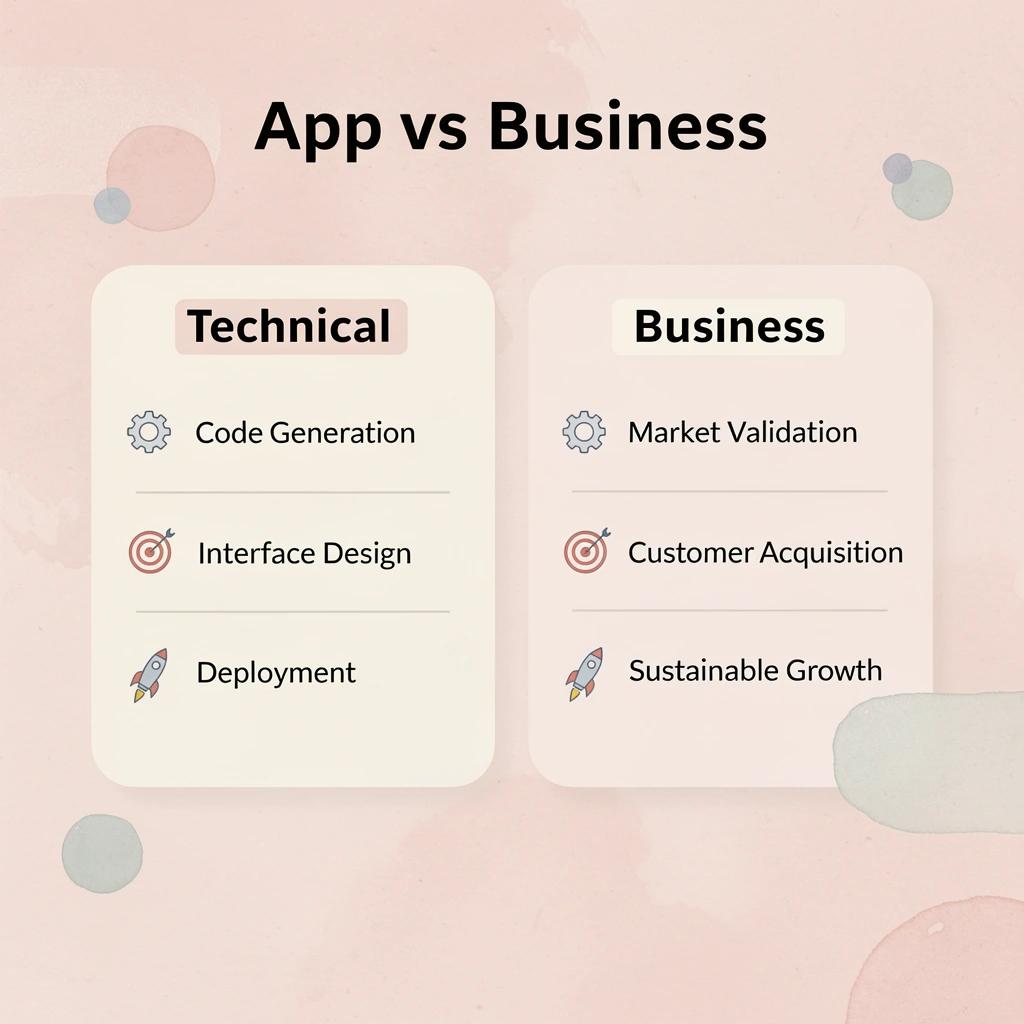
AI-powered development tools now handle code generation, interface design, and deployment in hours instead of weeks. The technical barrier that once prevented non-technical founders from launching software companies has disappeared.

🎯 Key Point: While AI tools have revolutionized the technical side of app development, they haven't touched the fundamental business challenges that determine success or failure.
"The technical barrier that once stopped non-technical founders from launching software companies has basically disappeared, but business fundamentals remain unchanged."

The business part hasn't gotten easier.
💡 Warning: Building an app is now the easy part - the real challenge lies in market validation, customer acquisition, and sustainable growth that no AI tool can automate.
What changed in the technology landscape?
For the first time in software history, the hardest part of starting a tech company isn't the technology. According to Business News Daily, 42% of small businesses now have mobile apps. AI coding assistants, no-code platforms, and automated deployment systems have made app creation accessible to anyone with an idea and an internet connection.
What challenges remain after building an app?
What hasn't changed is what happens after the app exists. Customer discovery still requires talking to real people about real problems. Marketing still demands understanding where your customers spend their attention and what messages resonate.
Sales still means building trust and closing deals. Support still requires responding to frustrated users. Operations still involves managing payments, refunds, uptime, and crises that arise when real people use real software.
What pattern emerges across failed startups?
The pattern appears repeatedly across failed startups. A founder spends three months perfecting features, refining the interface, and optimizing performance. They launch with genuine excitement. Then nothing happens. No customers arrive. No revenue appears. The app works perfectly, but the business doesn't exist yet.
Why isn't the software the real problem?
The problem wasn't the software. Building the product and building the business are fundamentally different challenges that require different skills, and AI hasn't automated the second. You can generate a landing page in minutes, but you still need to determine who needs it, why they'd pay for it, how to reach them, and what makes your solution worth choosing over alternatives or doing nothing.
Polsia, a web app development company, helps founders navigate this gap by combining AI-assisted development with strategic guidance. While AI handles code generation, the platform focuses on harder questions: what to build, for whom, and how to turn working software into sustainable revenue.
The system nobody automates
A business is a system that repeatedly solves a problem that people will pay to have fixed. The app is one part, but not everything. You need ways to find customers, convince them your solution works, deliver value consistently, support them when things break, improve based on feedback, retain them after the first purchase, and grow without collapsing under operational complexity.
What challenges can't code solve?
None of those challenges get solved by better code. They get solved by talking to customers, testing messages, analyzing behavior, trying new positioning approaches, building trust, and creating scalable systems. The founders who succeed aren't those with the most elegant architecture—they're the ones who built distribution channels, confirmed customer demand, and created systems that convert interest into revenue.
Where does the real work begin?
But if AI can build the app this easily, what does it accomplish, and where does the real work begin?
What Most AI App Builders Actually Help You Do
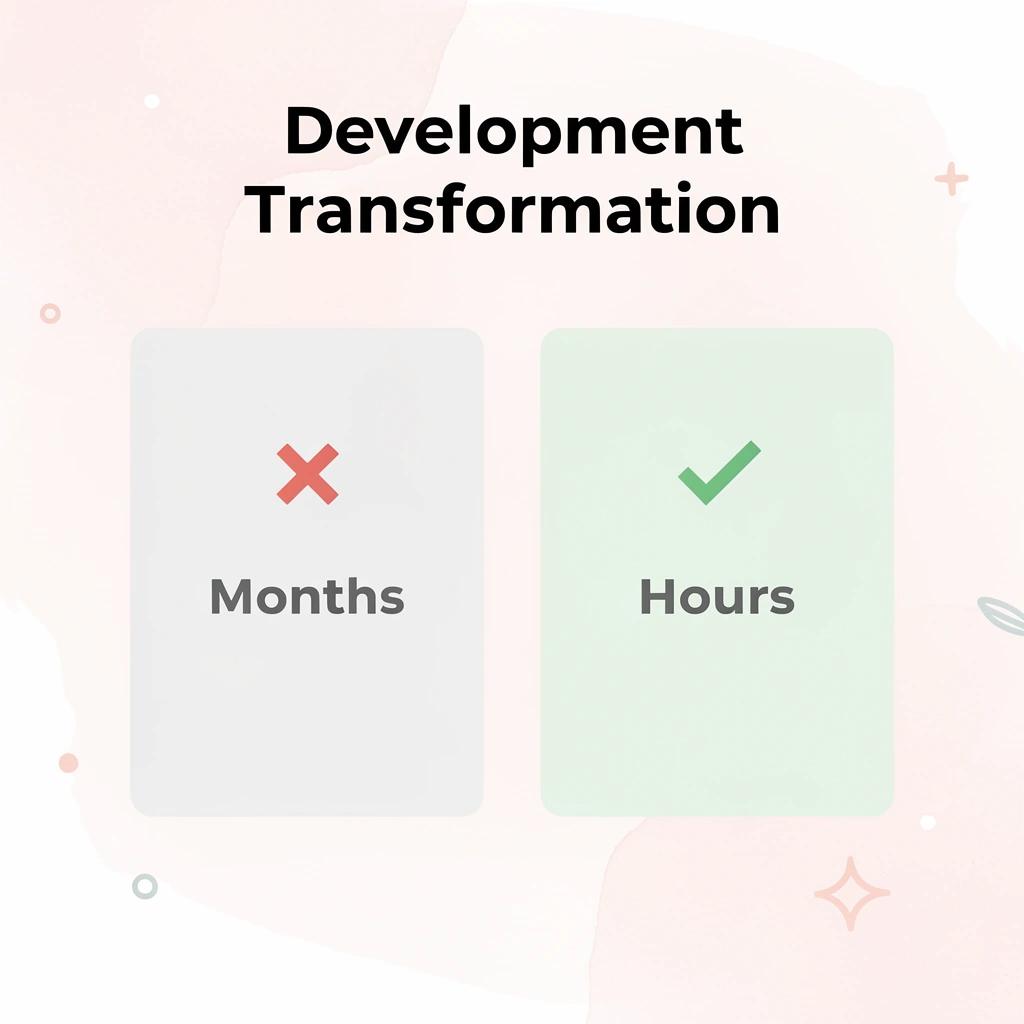
AI app builders remove the technical barrier to building. They let you describe an idea in plain language and generate a working prototype, landing page, or web application in hours instead of months, without hiring developers, raising capital, or spending years learning to code.
🎯 Key Point: The biggest advantage isn't just speed—it's accessibility. Non-technical founders can now validate ideas and build functional apps without the traditional barriers of technical expertise or large budgets.
"AI app builders democratize software development, allowing anyone with an idea to create functional applications in a fraction of the traditional time." — Tech Innovation Report, 2024

⚠️ Warning: While these tools are powerful for rapid prototyping, they're not a complete replacement for custom development when you need advanced features or enterprise-scale solutions.
How do AI app builders accelerate MVP creation?
The most valuable use case is building minimum viable products quickly. An MVP tests whether customers care about your idea, not whether you can write elegant code. You can launch something that works, gather real feedback from users, and decide whether to keep going or change direction without spending months or significant resources.
Why does prototyping matter for validation?
Prototyping turns abstract ideas into real products that people can use and test. A working prototype lets potential customers try out workflows, investors evaluate functionality, and partners assess feasibility. Zapier reports that 80% of AI app builders focus on creating internal tools, dashboards, and CRUD (Create, Read, Update, Delete) applications—the types of products founders need to test market demand without extensive development.
How do AI app builders accelerate product validation?
Modern AI tools create landing pages, user interfaces, databases, and workflows that once required specialized knowledge. This enables founders to test ideas in days instead of months, identify weak concepts earlier, and avoid spending time on unwanted products.
Who benefits most from lower startup costs?
Lower startup costs help first-time founders, side hustlers, and solopreneurs the most. Someone working evenings and weekends can spend more time talking with customers and marketing, rather than on development.
Non-technical entrepreneurs benefit most because launching software without writing code removes a barrier that previously prevented people from starting. Reflex Blog notes that 80% of AI app builders focus on frontend UI generation, enabling founders without design or development backgrounds to create professional applications previously out of reach.
What challenges remain after reducing development friction?
AI app builders excel at streamlining development: they help you build faster, test for less money, and validate ideas with less risk. However, building the product is usually not where founders get stuck.
Related Reading
10 Best AI App Builders
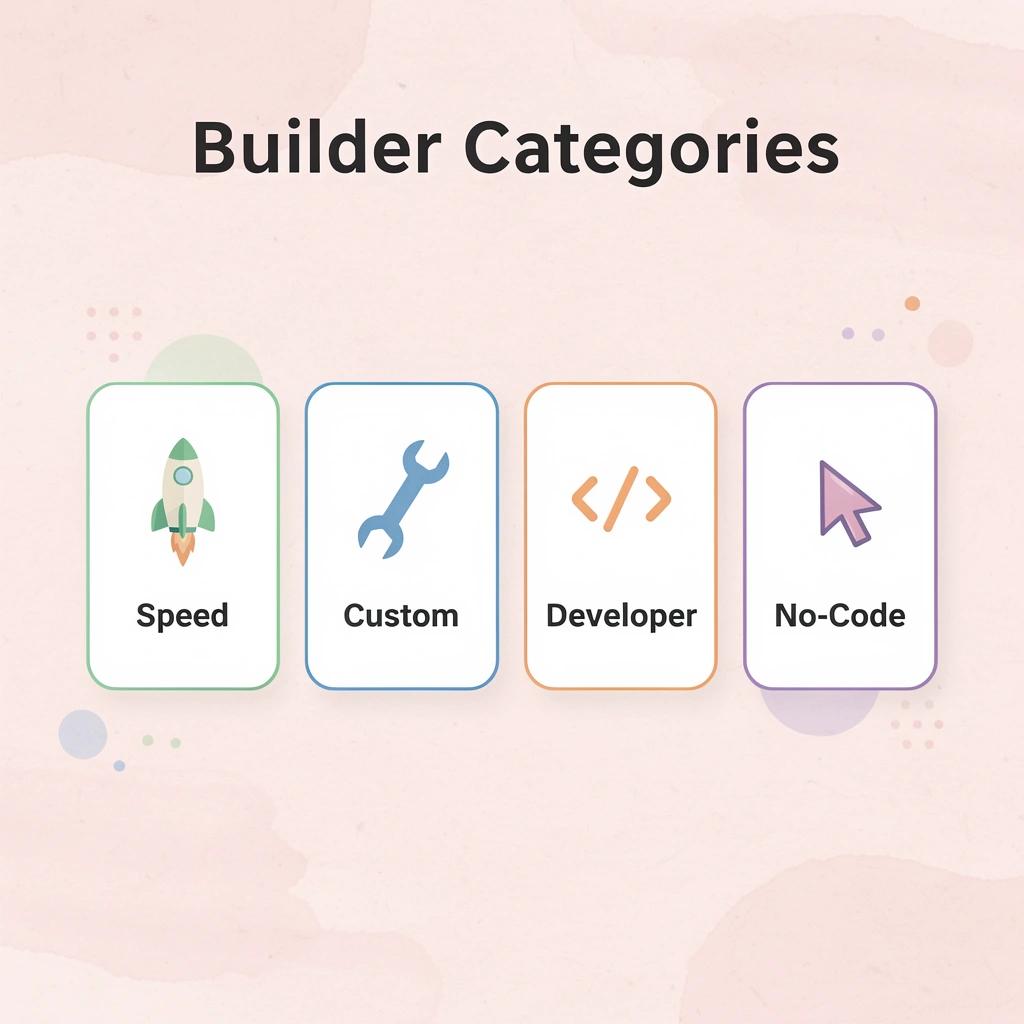
AI app builders solve different problems: some focus on speed, others emphasize customization, and some target developers while others serve non-technical founders. The best choice depends on your goals.

🎯 Key Point: The right AI app builder for your project depends on your technical expertise, timeline requirements, and customization needs.
"Choosing the wrong AI app builder can cost you weeks of development time and force you to start over with a different platform." — Development Best Practices, 2024

Builder Types, Best Uses & Strengths
- Speed-Focused Builders
- Best for: Rapid prototyping
- Key strength: Fast deployment and quick validation
- Customization-Heavy Builders
- Best for: Complex applications
- Key strength: Flexible features and extensive customization
- Developer-Oriented Builders
- Best for: Technical teams
- Key strength: Advanced controls and deeper system access
- No-Code Platforms
- Best for: Non-technical users
- Key strength: Easy-to-use interface with minimal learning curve
💡 Tip: Start by defining your core requirements and technical constraints before evaluating specific AI app builders to avoid feature overwhelm.
1. Polsia
Best for
Founders who want help building and operating a business
Strengths
- Business planning alongside product creation
- MVP and full-stack product development
- Automated marketing support
- Customer communication and operational workflows
- Infrastructure setup
- Designed for solo founders without technical or business teams.
Most AI app builders focus on software creation. Polsia takes a wider approach by helping founders plan, build, market, and operate a business—especially valuable for first-time founders. The platform runs continuously, handling everything from shipping code to running ads to replying to customers, eliminating the need to hire a human team before launch.
2. Lovable
Best for
Quick MVP development and testing ideas
Strengths
- Fast app creation using natural-language prompts
- Easy to use for beginners
- Quick cycles for making changes
Lovable focuses on speed and simplicity, making it popular with entrepreneurs seeking rapid prototyping.
3. Bolt
Best for
Fast full-stack web application development
Strengths
- Browser-based development experience
- Full-stack application generation
- Rapid prototyping
- Immediate deployment workflows
Bolt appeals to founders who want to quickly generate and test applications without setting up their own computers. The entire process happens in your browser.
4. Replit
Best for
Founders who want flexibility and development control
Strengths
- AI-assisted coding environment
- Supports multiple programming languages
- Collaborative development capabilities
- Suitable for both beginners and experienced builders
Replit bridges traditional coding and AI-assisted development for users seeking more customization than pure no-code platforms. Users report 10x faster development compared to traditional coding when using AI-assisted platforms like this.
5. Bubble AI
Best for
No-code SaaS products and custom web applications
Strengths
- Extensive customization
- Powerful workflows and database functionality
- Large ecosystem and community
Bubble remains one of the most established platforms for founders seeking significant control without having to become developers. The learning curve is steeper than simpler builders, but the scope of what you can build is considerably higher.
6. Glide
Best for
Internal tools and business applications
Strengths
- Simple app creation process
- Spreadsheet-based workflows
- Fast deployment
- Strong business use cases
Glide is particularly useful for entrepreneurs who want to quickly turn data and workflows into working applications. If your product concept centers around organizing or displaying existing information, Glide removes most technical barriers.
7. Softr
Best for
Client portals, directories, and business websites
Strengths
- User-friendly interface
- Fast setup process
- Strong database integrations
- Suitable for non-technical users
Softr helps founders launch practical business applications without extensive technical knowledge. The platform excels at membership sites, client portals, and internal directories.
8. v0
Best for
UI generation and front-end development
Strengths
- High-quality interface generation
- Fast component creation
- Modern design outputs
- Useful for accelerating product design workflows
Many founders use v0 to quickly create polished user interfaces before expanding into full application development. The tool focuses specifically on the visual layer rather than backend logic or database structure.
9. Cursor
Best for
Developers seeking AI assistance with coding
Strengths
- Deep code generation capabilities
- AI-assisted debugging
- Productivity-focused workflow
- Works well for experienced technical users
Cursor is an AI-powered development environment that speeds up coding rather than replacing it. It's designed for programmers who already know how to code, not for those seeking to build without coding.
10. Windsurf
Best for
AI-native software development
Strengths
- AI-driven coding assistance
- Strong developer workflows
- Rapid iteration capabilities
- Designed around AI-first development
Windsurf appeals to technical founders and developers seeking to accelerate software development through AI-assisted coding, significantly reducing development time.
What should you prioritize when selecting an AI app builder?
Most AI app builders focus on one challenge: helping you build software faster. Apps built with platforms like Newly have been downloaded over 2 million times collectively from major app stores, proving these tools produce market-ready products.
When founders struggle with platform selection, the real issue isn't which builder has better features: they're solving for the wrong problem. They believe faster development will solve their go-to-market problem. It won't.
Which AI app builder matches your specific goals?
If your main goal is to create an MVP or test an idea, tools like Lovable, Bolt, Bubble AI, Glide, or Softr are strong choices. For AI-assisted development with more technical control, Replit, Cursor, Windsurf, and v0 offer greater flexibility. If your challenge extends beyond product development to include planning, marketing, customer acquisition, and business operations, a platform designed for comprehensive business-building may serve you better.
Many founders discover that building the app is not the hardest part of entrepreneurship. Shipping faster doesn't solve the problem most founders face once the code is complete.
Why Most Founders Get Stuck After the MVP
Building an MVP has never been easier. Launching a business remains difficult. Creating a product and creating a company require different skill sets.

🎯 Key Point: The gap between technical execution and business strategy is where most founders stumble. You can code a perfect solution but still fail to build a sustainable company.
"95% of startups fail not because of technical issues, but due to market-related problems and poor business execution." — CB Insights Startup Failure Report

⚠️ Warning: Don't confuse product validation with business validation. Your MVP might work flawlessly, but that doesn't guarantee market fit, sustainable revenue, or scalable growth.
What can AI app builders actually solve?
AI app builders can generate code, interfaces, and workflows in hours. They cannot generate customers. Many founders successfully launch products but struggle to gain traction afterward. According to research from Startup Genome, 70% of startups scale prematurely, often investing heavily in product development before establishing sustainable customer acquisition and market demand.
Why do founders focus on features over customers?
First-time founders usually spend months building features and weeks thinking about customers. Product development feels productive: new features appear, bugs disappear, and progress is visible. Customer acquisition is different. Results are uncertain, outreach gets ignored, campaigns fail, and content takes time to gain traction.
Why does distribution matter more than product quality?
A mediocre product with effective distribution outperforms a superior product nobody discovers. Yet distribution remains one of the least understood aspects of entrepreneurship among first-time founders. Launching requires creating content, testing messaging, building audiences, experimenting with acquisition channels, and continuously refining the approach.
How do time constraints affect solo founders using AI app builders?
For solo founders, time constraints compound every challenge. Most are building around full-time jobs and other responsibilities, meaning every hour spent improving the product is an hour not spent acquiring customers.
Consider two founders using the same AI app builder. The first spends four months refining features before launch. The second launches after six weeks and spends the remaining time interviewing prospects, building an audience, publishing content, and testing acquisition channels. Six months later, the first founder has a better product. The second founder has revenue.
What transforms an app into a real business?
The difference is customer acquisition. A working app is not a working business. The MVP proves you can build something; the company only begins to exist when you can regularly attract customers, generate revenue, and operate the systems needed to support growth.
But knowing you need customers and getting them are two different challenges.
What Founders Actually Need Beyond an AI App Builder
The real bottleneck isn't building the app—it's everything after launch. You need systems that attract customers, convert leads, handle support, manage operations, and execute marketing campaigns. An AI app builder gets you to launch day. What you need is something that runs the company after.

🎯 Key Point: Most founders focus on the wrong problem—they obsess over building features when they should be building business systems that generate revenue and retain customers.
"The real challenge isn't creating the product—it's creating the sustainable business systems that turn your app into a profitable company." — Post-Launch Reality Check

⚠️ Warning: An AI app builder is just the starting line, not the finish line. Without proper customer acquisition, retention strategies, and operational workflows, even the most perfectly built app will struggle to survive in the market.
What business questions should you answer before building?
Most founders skip the hard questions until after they've built something. Who will pay for this? What specific problem does it solve that people currently tolerate or solve differently? Which market segment has the highest pain and lowest resistance? These questions feel abstract when you're excited about features, but they determine whether your first 100 customers take three weeks or three years to acquire.
How do you balance building with market research as a solo founder?
Strategy is a living system of decisions about where to focus, what to ignore, and how to use your limited hours each week. When working alone, every hour spent coding is an hour not spent talking to potential customers or improving your business positioning.
Customer Acquisition Systems
You can build a perfect product that nobody finds out about. According to Mocha Blog, there are now over 50 AI app-builder platforms in active use. The problem isn't making products; it's getting people's attention and earning their trust.
Getting customers requires consistent work across multiple channels: content marketing, paid advertising, partnerships, cold outreach, community building, and search optimization. A founder who successfully launches an MVP often discovers they must simultaneously become a marketer, copywriter, media buyer, and salesperson.
What operational challenges emerge when your app goes live?
Someone needs to answer support emails at 11 PM, monitor system performance, respond to user feedback, update documentation, manage billing issues, and handle the countless operational tasks that arise once real customers use your product. The work doesn't pause for sleep or development focus.
How can autonomous systems replace traditional team building?
Traditional advice says to hire help or find a co-founder, but that assumes you have capital, time to recruit, or a network willing to join an unproven idea. Platforms like Polsia take a different approach, providing autonomous systems that handle customer communication, run marketing campaigns, and manage operations continuously without requiring you to build a team first.
The philosophical shift matters more than the tactical one. For decades, we assumed building a company meant assembling people. Now we're discovering it might mean assembling systems. The founder who understands this can move from idea to revenue faster than someone still trying to hire their way to traction.
What happens when those systems work together instead of requiring you to orchestrate every piece manually?
Related Reading
- Softr Alternatives
- Replit Alternatives
- Hire App Developer
- Appsheet Alternatives
- VS Code Alternatives
- Mobile App Ideas
How Polsia Helps Founders Build and Operate a Business
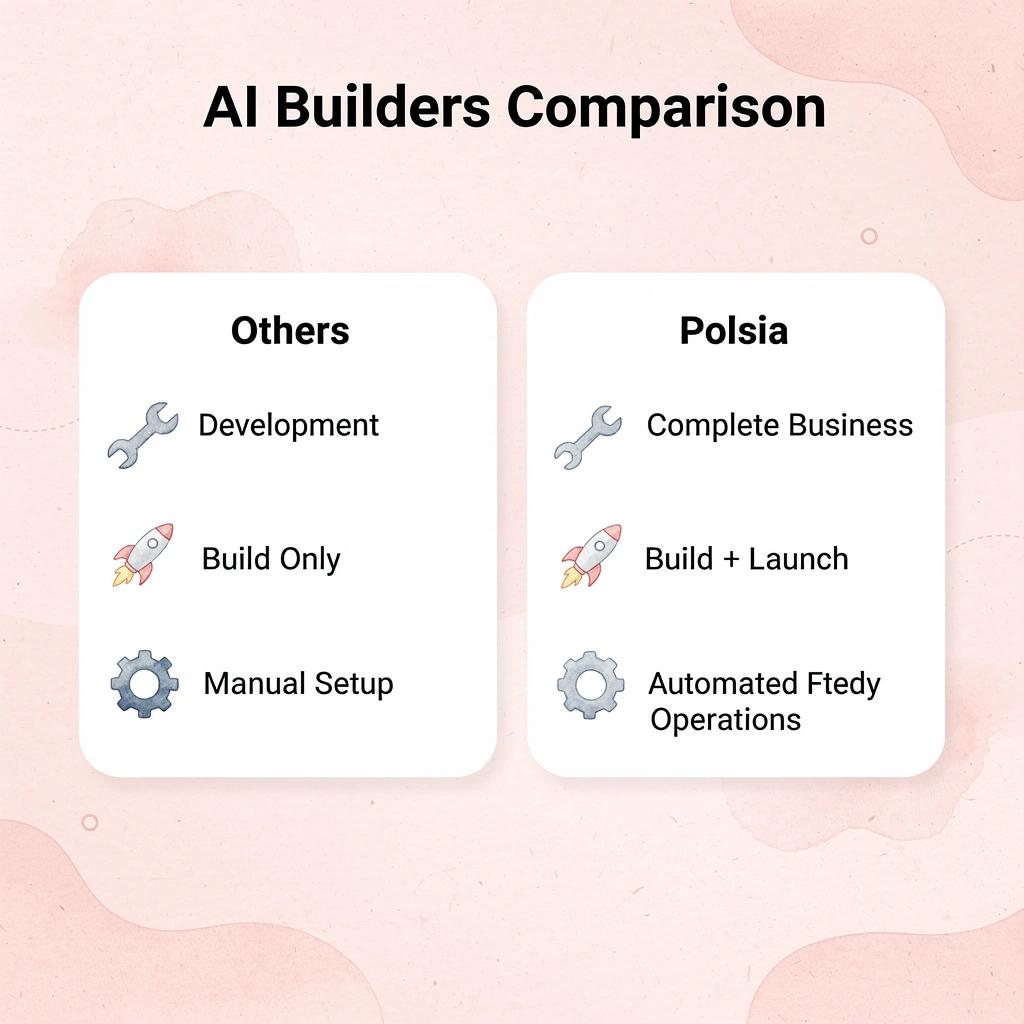
Most AI app builders help you ship software. Polsia helps you run a company. Launching a product is only the beginning—you still need customers, revenue, and systems that work when you're asleep or at your day job.

🎯 Key Point: Building software is just step one—the real challenge is creating sustainable business operations that generate revenue without constant hands-on management.
"Launching a product is only the beginning—you still need customers, revenue, and systems that work when you're asleep or at your day job." — The reality of successful entrepreneurship

💡 Tip: Focus on business infrastructure from day one. The most successful founders think beyond product development to customer acquisition, revenue generation, and automated systems that scale.
Why is the traditional hiring path unrealistic for solo founders?
The traditional path requires assembling a team: a developer, marketer, and support person. Each hire costs money before generating results and takes weeks to find and onboard. For a solo founder testing an idea at night and on weekends, that path isn't feasible.
How does Polsia operate as an autonomous business system?
Polsia works as an independent system that handles all kinds of business activities: planning your roadmap, shipping features, running ad campaigns, responding to customer inquiries, and posting social content. The system runs continuously, learning from results and adjusting based on what works. You move from managing tasks to reviewing outcomes.
What can a solo founder accomplish with automated systems?
A founder working alone can launch a product, acquire early customers through automated outreach and paid campaigns, handle support, and maintain marketing momentum without hiring. The bottleneck shifts from "I need to find the right people" to "I need to make better strategic decisions about where the business should go next."
For decades, we assumed building a company meant coordinating people. Polsia suggests it might mean coordinating systems that handle execution while you focus on vision, positioning, and strategic choices that determine success. AI handles operations; you handle direction. This distinction defines whether you're planning your first hire or generating revenue from your second product.
Start or Grow your Existing Business with Polsia Today
If you're researching AI app builders to start a business, ask: who handles everything after the app is built? Polsia lets you create your MVP, develop a business roadmap, launch marketing campaigns, and automate operations from one platform. Start with your idea for $49/month.

🎯 Key Point: Most AI app builders focus only on development, leaving you to figure out business strategy, marketing, and operations on your own.
"$49/month gives you access to a complete business platform that handles everything from MVP creation to automated operations." — Polsia Platform Features
💡 Tip: Don't just build an app — build a complete business ecosystem that can scale from day one with integrated marketing automation and operational workflows.