Best Mobile App Builder for Launching a Real Business Faster
Building a mobile app no longer requires months of coding expertise or massive budgets. Modern mobile app builders offer drag-and-drop platforms, cross-platform capabilities, vibe coding, and no-code solutions that can launch businesses from concept to market in weeks rather than years. The key lies in selecting tools that match specific business needs while delivering native app features and seamless functionality across iOS and Android devices.
Smart businesses skip the learning curve of complex development environments by partnering with experienced teams who understand both the technical requirements and market demands. Rather than wrestling with restrictive templates or limited customization options, successful app launches happen when entrepreneurs focus on their core business while technical experts handle the development complexities through a trusted web app development company.
Table of Contents
- Why Most People Never Launch Their Mobile App Idea
- What Makes a Mobile App Builder "The Best"?
- The Biggest Mistake First-Time Founders Make
- How to Evaluate App Builders Beyond Features
- Why Building an App Is Only the Beginning
- How Polsia Helps Founders Build and Run a Business
- Start or Grow your Existing Business with Polsia Today
Summary
- Mobile app builders promise speed and simplicity, but 43% of startup failures stem from poor product-market fit, according to CB Insights' analysis of startup failures. The real challenge isn't building software. It's building something people actually want. Most founders spend months perfecting features without ever validating whether customers will pay, which explains why technical capability matters far less than market execution in determining which products survive their first year.
- Speed determines how quickly you can test assumptions and gather feedback. Research shows that 25% of users abandon an app after just one use, often because the product never met their actual needs. That failure starts during development, when founders build features that sound impressive but solve problems nobody has. Platforms that help you move from concept to a working prototype in weeks, not months, give you real customer feedback while competitors are still planning.
- Distribution gaps kill more apps than technical problems. Your product exists, but potential customers don't know it exists, can't find it, or don't trust an unknown company enough to try it. SaaS benchmarks show customer acquisition costs increased 222% over eight years as digital channels became saturated. The apps that survive aren't always the best built. They're the ones that solved real problems, reached the right people, and executed consistently after launch.
- Post-launch operations create continuous demands most founders underestimate. Every user generates support requests, feature suggestions, and billing questions that require immediate responses. Marketing needs sustained investment across content creation, paid advertising, and email campaigns. Products require constant evolution in response to usage patterns and competitive pressures. The gap between building an app and running a business is where most solo founders get stuck.
- Traditional app builders help with development but leave marketing, customer support, analytics, and operations as separate problems you have to solve on your own. Each additional tool adds complexity, cost, and integration overhead. Successful founders don't just need software creation capabilities. They need repeatable systems for customer acquisition, support management, and product iteration that work together rather than adding more operational burden.
- Polsia's web app development company addresses this by treating product development, marketing, and operations as integrated functions within a single autonomous system rather than separate challenges founders manage independently.
Why Most People Never Launch Their Mobile App Idea
Millions of people have app ideas. Far fewer ever launch them. Most people believe the biggest obstacle is learning how to build an app, but this creates a dangerous trap: "I need the right app builder and everything else will fall into place." In reality, building the app is often one of the smaller challenges.

🎯 Key Point: The technical development isn't what stops most entrepreneurs—it's everything that comes before and after the coding phase.
"95% of mobile apps fail to achieve meaningful success, and the majority never even make it to the app store." — Mobile App Development Industry Report, 2024

⚠️ Warning: Focusing solely on the development process while ignoring market validation, user research, and launch strategy is a recipe for failure.
What technical uncertainties stop people from building apps?
The first barrier is technical uncertainty. Even with modern app builders, people worry about design decisions, feature requirements, integrations, databases, user authentication, payment processing, deployment, and maintenance. They must make product decisions affecting business success without coding knowledge. Hiring developers is expensive: custom mobile app development can cost tens of thousands of dollars or more, making traditional development out of reach for early-stage founders.
How does time constraint affect app development?
Time is another significant constraint. Many people who want to start a business work full-time jobs, attend school, care for families, or manage other responsibilities. Launching a product requires research, planning, testing, marketing, customer support, and ongoing improvements, all competing for limited hours. Ideas often remain ideas.
What makes poor product-market fit so dangerous for startups?
According to CB Insights' analysis of startup failures, 43% cited poor product-market fit as the most common cause. CB Insights found that 29% attributed failure to bad timing, while 19% pointed to unsustainable business models.
Most startup failures do not stem from founders' inability to write code. They happen because founders struggle with validation, positioning, pricing, customer acquisition, or business execution.
Why does customer validation matter more than perfect code?
Think about two founders: one spends six months building a polished app but never talks to potential customers; the other launches a simple version, gathers feedback, validates demand, and continuously improves based on real user behavior. The second founder often has a better chance of success, even with less sophisticated technology. The best mobile app builder helps founders navigate the entire journey from idea to business, not just the coding part.
But what does "best" mean when every platform claims to be the solution?
Related Reading
What Makes a Mobile App Builder "The Best"?
The best mobile app builder closes the gap between where you are now and the business results you need. A platform for quick prototyping won't serve a founder needing enterprise-grade scalability. A feature-rich tool designed for developers will frustrate someone shipping an MVP by next week. The right choice depends on whether you're a non-technical solo founder testing an idea, a startup validating product-market fit, or a team scaling an existing product.
🎯 Key Point: The perfect app builder for your specific situation matters more than finding the platform with the most features.

"Choosing the wrong development platform can cost startups an average of 3-6 months in lost development time and $50,000-$200,000 in additional costs." — TechCrunch Startup Survey, 2024
💡 Tip: Before comparing platforms, define your timeline, technical expertise level, and growth expectations for the next 12 months — this will eliminate 80% of unsuitable options immediately.
User Type
Non-technical founder
Primary Need
Speed to market
Key Feature Priority
Drag-and-drop simplicity
Startup team
Primary Need
Validation tools
Key Feature Priority
Analytics integration
Scaling business
Primary Need
Performance
Key Feature Priority
Enterprise scalability
Ease of Use
For first-time founders, ease of use determines whether a platform becomes a tool or an obstacle. Powerful features matter little if you spend weeks learning the interface instead of building. The best app builders simplify technical complexity so you can focus on solving customer problems rather than understanding software architecture.
Development Speed
Speed matters because every month spent building is a month without customer feedback. According to Glen Allsopp's analysis of 250 search results, 169 out of 250 "best X software" pages follow nearly identical structures, suggesting most platforms prioritize feature lists over helping founders launch. A strong app builder shortens the cycle for testing ideas, gathering feedback, and iterating, reducing the risk of spending months building features nobody wants.
Customization and Scalability
A platform must be easy to use, but it also needs to be flexible. Some builders simplify basic app creation, but this can become limiting as your product grows. Check whether a builder supports custom workflows, unique business logic, advanced user experiences, and third-party integrations. A platform that works today but stops your growth tomorrow will force expensive migrations or rebuilds. Can it handle more users, growing data requirements, and additional features without breaking down? That question matters more than most founders realize.
Integrations and Deployment Support
Modern businesses rarely work in isolation. Your app will need to connect with payment processors, CRM systems, analytics platforms, marketing tools, and customer support software. Strong integration capabilities save time and reduce operational complexity as you grow.
Deployment support matters as much as building the app itself. You still need to deploy, maintain, update, and manage it. Some platforms provide comprehensive support throughout this lifecycle, while others leave founders responsible for much of the technical implementation—a barrier for non-technical entrepreneurs trying to move from development to launch.
How do different platforms approach app lifecycle management?
Traditional app builders assume you'll handle execution: choosing templates, setting up integrations, managing deployment, and acquiring users. This works if you have time, technical skill, or a team. For solo founders needing speed and control, platforms like Polsia offer a different approach.
Instead of providing tools that require human execution, Polsia automatically handles the entire lifecycle from roadmap to deployment to marketing. It doesn't help you build an app; it runs the operations required to turn that app into a functioning business.
But even the most capable platform won't save you from the mistake that kills most launches before they begin.
The Biggest Mistake First-Time Founders Make
The most expensive mistake is assuming the product is the business. Founders pour months into development, then discover that building software and building a company require completely different skills. The second challenge often determines survival.

🎯 Key Point: Product development is just the first step—business building involves sales, marketing, operations, and team management that most technical founders underestimate.
"70% of startups fail not because of bad products, but because of poor business execution and market fit issues." — CB Insights Startup Failure Report, 2023

⚠️ Warning: Don't fall into the "build it and they will come" trap. Customer acquisition, revenue generation, and sustainable growth require dedicated focus from day one, not after the product is "perfect."
What's the difference between building and selling an app?
Creating a functional app solves a technical problem. Turning that app into revenue solves a market problem. According to CB Insights, 42% of failed startups cited a lack of market need for their product. The failure wasn't bad code quality or missing features: it was building something people didn't want, couldn't find, or wouldn't pay for.
How do you validate real market demand?
Most founders validate ideas by asking friends, reading competitor reviews, or imagining user scenarios. Real validation requires conversations with strangers matching your target customer profile, testing whether people will pay before writing code, and measuring what people do rather than collecting opinions. The difference between assumed demand and proven demand separates ideas that grow from those that stall.
Why does launching an app not guarantee success?
Launching makes your app available, but it doesn't make people know about it. Potential customers don't know it exists, don't understand what problem it solves, or don't trust an unknown company enough to try it. Getting customers requires a clear plan: channels that reach your target audience, messaging that quickly demonstrates value, and conversion paths that reduce friction from discovery to sign-up.
Many founders spend 90% of their energy on the product and 10% on reaching customers. The split should often reverse. A simpler product with strong distribution channels outperforms a complex product that few people know about. If customers can't find you, your features don't matter.
How can solo founders manage both development and marketing?
For solo founders who lack time to manage both development and marketing, platforms like Polsia can transform operations. Instead of building an app and then figuring out how to sell it, the system integrates the product roadmap, deployment, and customer acquisition. You activate an autonomous system that runs the full business cycle while you focus on strategy and validation.
The Bureau of Labor Statistics reports a 48.4% failure rate by year five. The apps that survive aren't always the best-built; they're the ones that solve real problems, reach the right people, convert interest into revenue, and execute consistently after launch. Product development opens the door. Everything that happens next determines whether you walk through it.
But knowing this still leaves one question unanswered: how do you choose the platform that supports both building and surviving?
How to Evaluate App Builders Beyond Features
Most founders evaluate app builders in the wrong order. They compare drag-and-drop interfaces, template libraries, and integration catalogs before selecting the platform with the longest feature list. The better question isn't which builder has more capabilities, but which one supports the entire path from idea to revenue.

🎯 Key Point: The most important evaluation criteria aren't about features — they're about business outcomes. Look for platforms that support user acquisition, monetization strategies, and long-term scalability rather than just development speed.
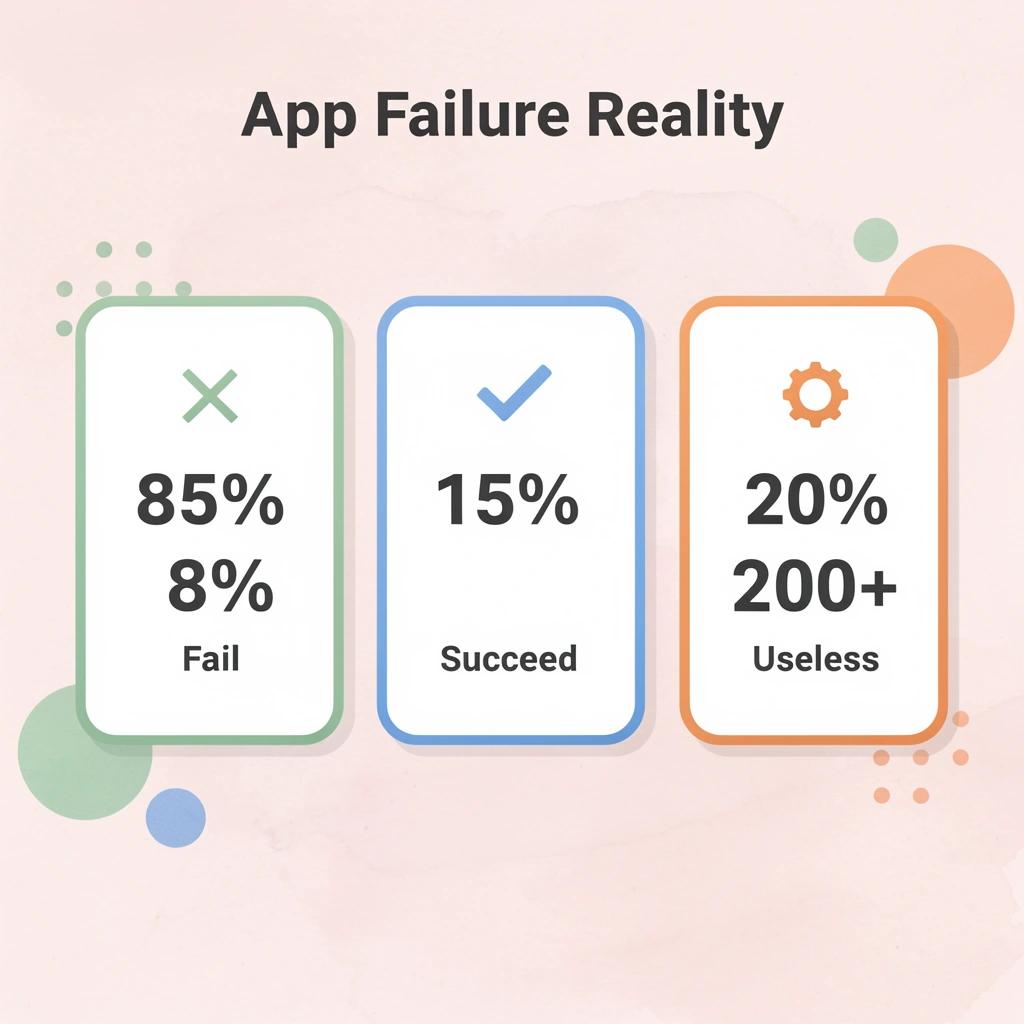
"85% of app projects fail not because of technical limitations, but because founders choose tools that don't support their go-to-market strategy." — App Development Survey, 2024
⚠️ Warning: Don't fall into the feature comparison trap. A platform with 200+ integrations means nothing if it can't handle payment processing, user analytics, or performance optimization at scale.
Traditional Evaluation
- Template count
- Drag-and-drop ease
- Integration list
- Design flexibility
Revenue-Focused Evaluation
- Monetization options
- Performance metrics
- Scalability support
- User acquisition tools
Why is testing before building so important?
The most expensive mistake is building something nobody wants. Before writing code, you need to be confident that real people will pay for your product. According to Localytics, 25% of users stop using an app after one use, often because it didn't meet their needs. That failure starts during development, when teams build features that sound impressive but solve problems that don't exist.
How can you validate concepts quickly?
A useful platform lets you test ideas quickly. Can you create a landing page in an afternoon, gather email signups, and measure interest before spending weeks on development? Can you build a simple prototype that shows the main value without perfecting every detail? The faster you validate assumptions with real people, the less likely you are to waste months on an unpopular product.
How quickly can you reach the market?
Speed matters more than perfection when testing ideas. Your first version needs only the minimum features to solve one problem well enough that people will use it. A platform that moves you from concept to launch in weeks, not months, provides real feedback while competitors are still planning.
Ask whether the platform encourages rapid experimentation, requires minimal technical knowledge, and lets you add features step by step based on user feedback. The goal is to learn fast and pivot before investing everything in the wrong direction.
Why is rapid iteration crucial for app success?
Your first version will be wrong about something—whether it's onboarding confusion, irrelevant features, or unanticipated customer needs. Research from Google shows that apps with poor performance see a 62% higher uninstall rate, and such problems often surface only when real users interact with your product under unexpected conditions.
How does quick iteration create competitive advantage?
The ability to make changes quickly becomes a competitive advantage. If updating features, testing improvements, or adjusting workflows requires rebuilding large portions of your app, innovation slows. A strong platform enables rapid iteration. The team that can test ten improvements in the time it takes another to test two will learn faster, adapt faster, and win.
Why does distribution matter more than features?
Building software doesn't create demand. You still need to reach people, convince them that your solution matters, and convert interest into users. Many app builders focus entirely on development and leave you to handle marketing on your own.
Distribution often matters more than product quality: a simpler app with strong distribution will outperform a sophisticated app that nobody discovers.
What marketing support should you look for?
Determine whether the platform delivers real customer acquisition value. Can it create landing pages that convert visitors? Does it integrate with email marketing tools? Can you track user sources and identify which channels drive signups?
Most solo founders cannot afford a marketing team and need tools that enable them to acquire customers without specialized skills. Platforms like Polsia integrate marketing and customer acquisition into product development rather than treating them as separate post-launch problems.
How do you know if a platform will support long-term growth?
A platform that works for your first version can become a problem six months later. Founders who outgrow their tools face migrations, rebuilding efforts, and operational disruptions that drain time and money, often when growth is accelerating, and you can least afford the distraction.
What scaling capabilities should you evaluate before making a choice?
Consider whether the platform can grow with your business: handle more users without slowing down, support new products or revenue streams without changing tools, and manage larger marketing efforts and complex operations. The best mobile app builder isn't the one that gets you to launch—it's the one that remains useful as your business expands beyond your original vision.
But none of this matters if you don't understand what happens after someone downloads your app.
Why Building an App Is Only the Beginning
The Post-Launch Reality
Getting users requires a repeatable system for downloads, signups, and active usage. Marketing determines whether your product survives its first year. Low-Code Statistics and Trends 2025 reveal that 25% of apps are abandoned after first use, so successful downloads don't guarantee sustained usage.
Customer Support Becomes Operational Overhead
Every user creates support needs: questions about features, bug reports, feature requests, password resets, billing issues, and onboarding confusion. Support requests grow with your user base, and slow response times damage customer retention faster than missing features. Support is an ongoing responsibility that scales with each new customer.
Marketing Requires Sustained Investment
Launch announcements generate temporary attention. Sustained growth requires ongoing content creation, paid advertising, social media presence, email campaigns, partnership development, and performance optimization. Recent SaaS benchmarks show acquisition costs increased 222% over eight years as digital channels became saturated and competition intensified. The companies that win aren't those with the best product; they're those that can profitably acquire customers at scale.
Product Evolution Never Ends
Your first version answers the question of whether you can build something. The next hundred versions answer the question of whether you can build something people want to keep using. Customers identify missing features, competitors raise baseline expectations, and market conditions shift. Successful products evolve continuously based on real-world feedback, usage patterns, and competitive pressure. Static products lose relevance quickly.
Why do most mobile app builders fall short after launch?
Most mobile app builders help you launch, but not operate what comes after. You still need separate systems for marketing automation, customer support, analytics, payment processing, email campaigns, and product updates. Each tool adds complexity, cost, and integration overhead. Building was never the hard part; running everything that happens after launch separates sustainable companies from the rest.
Related Reading
- Softr Alternatives
- Replit Alternatives
- Hire App Developer
- Appsheet Alternatives
- VS Code Alternatives
- Mobile App Ideas
How Polsia Helps Founders Build and Run a Business
Polsia replaces the need for a technical co-founder, development agency, marketing team, and operations staff with a single independent AI system. Our platform helps you plan your business, develop your product, get customers, manage operations, and keep everything running while you sleep.
🎯 Key Point: Instead of hiring multiple specialists or agencies, Polsia consolidates all essential business functions into one AI-powered platform that works 24/7.

Most founders fail not because of weak ideas, but because they cannot execute across every business function. You might build a great app, but without marketing, customer support, infrastructure management, and consistent momentum, the product sits unused. Polsia addresses that gap by functioning as an AI co-founder handling the full lifecycle from roadmap to revenue.
"Most startups fail because they can't execute across multiple business disciplines simultaneously, not because their core idea lacks merit." — Startup Analysis Report, 2024
💡 Tip: Think of Polsia as your always-on business partner that never sleeps, never takes vacation, and handles the operational complexity that typically requires an entire team.
Planning and Product Development
Founders often waste months debating the viability of an idea and MVP features. Polsia structures business concepts into actionable roadmaps and builds full-stack applications, web products, and MVPs without requiring code or developers.
This eliminates the most common barrier to execution: lack of technical skills. According to a Ben Cera LinkedIn Post, Polsia reached a $10M annual run rate with 0 employees, demonstrating that autonomous AI execution can replace traditional hiring. The platform doesn't assist with development; it performs it.
Marketing, Customer Acquisition, and Operations
Building a product that nobody finds is the same as not building it at all. Polsia goes beyond making software to marketing it. It launches campaigns across cold email, Meta ads, and social media channels, acquiring customers simultaneously with development rather than as an afterthought.
Customer communication and operational complexity overwhelm solo founders as businesses grow. Polsia manages these interactions and handles infrastructure setup, reducing the administrative burden that typically consumes evenings and weekends. For entrepreneurs balancing a startup with a full-time job, this autonomy is the difference between stalling and sustaining momentum.
How does autonomous execution prevent founder burnout?
Traditional startups slow down when founders run out of time or energy. Polsia's autonomous capabilities keep development, marketing, customer support, and operations moving forward around the clock. You're no longer the bottleneck; the system continues working while you focus on strategy, partnerships, or rest.
What changes for first-time founders?
This changes what's possible for first-time founders. Instead of needing a team before you start, you can access technical, marketing, and operational capabilities through a single platform. The question shifts from "How do I build an app?" to "How do I build a business that can support itself?"
But knowing what's possible and starting are two different things.
Related Reading
- How To Create An App
- Best Vibe Coding Tools
- Lovable Ai
- Ai App Builders
- No Code Ai Tools
- Hire App Developer
- Mobile App Ideas
Start or Grow your Existing Business with Polsia Today
Start with Polsia for $49/month to turn your app idea into a business. In your first session, you'll receive a structured plan and learn how product development, marketing, and operations work together to help you launch faster without hiring a team or learning to code.

🎯 Key Point: Most founders delay because they're waiting for the right moment, perfect skills, or money to hire help. Platforms like Polsia give you independent capabilities across technical build, customer acquisition, and daily operations, so starting doesn't require giving up your current income or spending months learning new tools.
"The founders who win aren't those with the best initial idea—they're the ones who start, adjust, and keep moving while others plan."

💡 Tip: Your first move matters more than your perfect move. Launch this week, get feedback from real people, and let it shape what you build next. The founders who win aren't those with the best initial idea—they're the ones who start, adjust, and keep moving while others plan.